

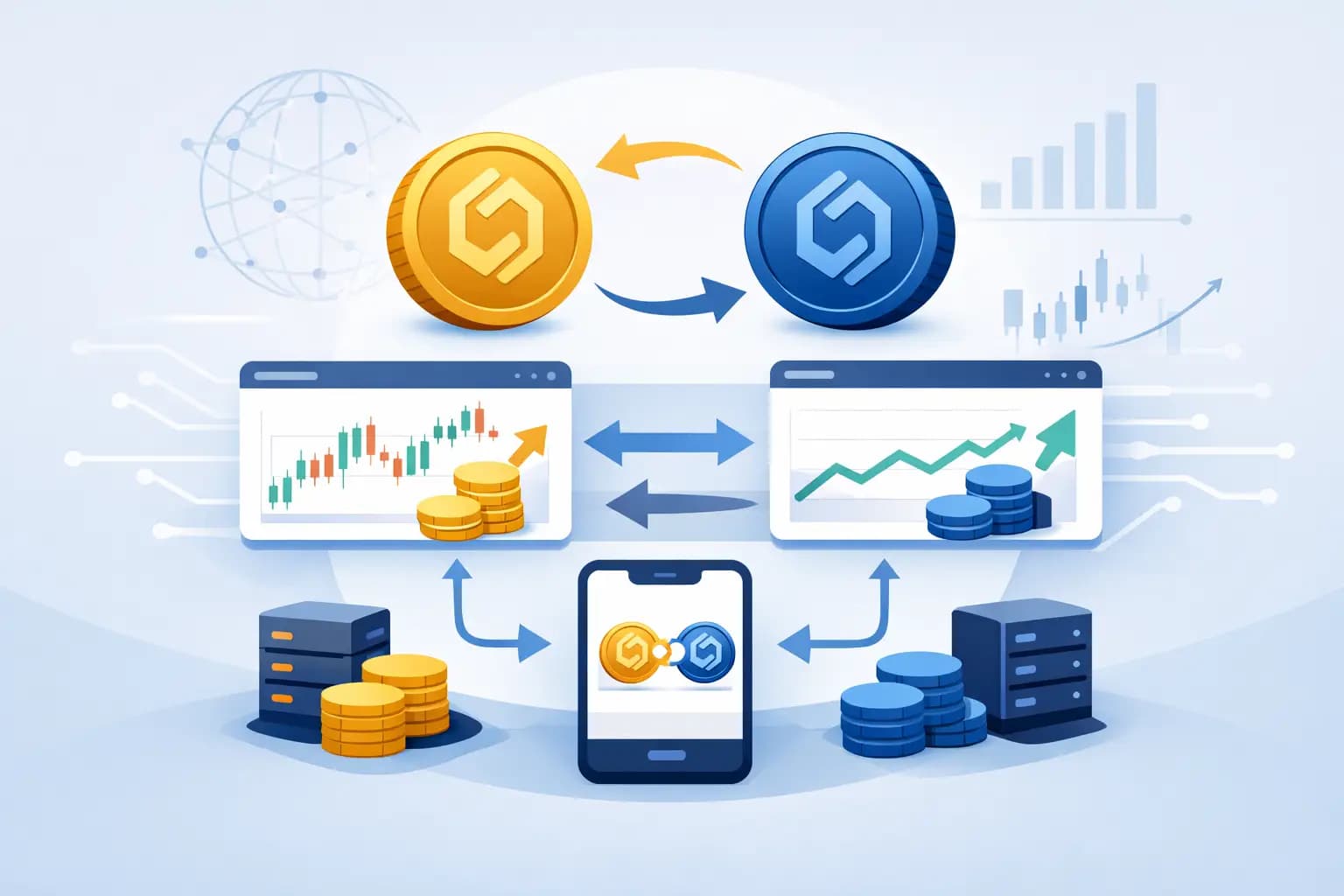
Price gaps do not stay open for long. A usable crypto arbitrage swap workflow example is less about theory and more about what happens between spotting the spread and landing the final asset in the right wallet without losing time to avoidable delays.
For most active traders, the real problem is not finding an occasional mismatch. It is execution. Funds sit on the wrong chain, the destination wallet needs a quick risk check, the swap route is unclear, and network costs start eating the edge. A workable process needs speed, visibility, and enough control to avoid turning a small spread into a bad trade.
What this crypto arbitrage swap workflow example is solving
Take a simple case. You hold USDT on TRON, see a pricing advantage for ETH on another venue or chain, and want to move fast without handing funds to a custodian or bouncing across five separate tools. The goal is to convert, deliver, and verify with the fewest possible decision points.
That is where workflow matters more than any single swap rate. A quoted spread can look attractive at first glance, but your actual result depends on network fees, route timing, wallet readiness, settlement speed, and whether the destination side accepts the asset and chain exactly as sent. If one step breaks, the whole arbitrage idea gets weaker.
A clean process usually has five stages: confirm the opportunity, check the destination wallet, prepare the send side, execute the swap, and track settlement until funds arrive where they need to go. The details vary by chain and asset, but the structure is consistent.
Step 1: Confirm the spread after real costs
Before moving funds, calculate the spread against actual execution conditions. That means checking the source asset, the source network, the target asset, the target network, and the expected receive amount after fees. If the opportunity only works under ideal assumptions, it is probably not a real opportunity.
This is where many arbitrage attempts fail. A trader sees a nominal price difference, then loses the edge on chain fees, slippage, or a poor conversion route. The smarter move is to evaluate the trade as a workflow, not just a quote.
For example, if you are moving USDT on TRON into ETH on Ethereum, the spread must be strong enough to cover the full path. If the target venue needs native ETH on mainnet, receiving wrapped exposure on a different network may not help. Fast execution starts with matching the route to the actual next use of funds.
Step 2: Check the destination wallet before you send
If the wallet on the receiving side is tied to a counterparty, a business process, or a downstream exchange deposit, a quick risk screen can save a larger problem later. That is especially useful when you are sending into a wallet that will interact with another service that may flag or delay incoming funds.
This is not about slowing down the trade. It is about avoiding operational drag after the swap. A wallet AML check helps answer a simple question: does this address present obvious risk before you route funds into it?
In a tight arbitrage window, you may skip this for your own known wallets. But if the destination is newer, business-related, or part of a larger payment chain, screening adds control. Timing matters, but so does keeping funds usable once they arrive.
Step 3: Prepare the source side for speed
Good arbitrage execution starts before the trade. Your wallet should already hold the asset on the chain you expect to use most often. If you regularly move stablecoins through TRON because of lower transfer cost, that is not just convenience. It is part of your speed advantage.
This is also where network resource planning comes in. On TRON, resource costs can materially affect repeated transfers. If you are sending USDT on TRON often, securing energy instead of absorbing full fee friction each time can tighten the economics of the workflow. Small savings matter more in arbitrage because the edge is often thin.
Preparation also means using the correct destination details. Confirm the send amount, the refund conditions if applicable, and the exact target network. A wrong chain or wrong asset pair is not a minor mistake in arbitrage. It usually means the opportunity is gone before support can even review the case.
Step 4: Execute the swap with the route that fits the job
Now the actual swap. In this crypto arbitrage swap workflow example, the trader sends USDT on TRON and receives ETH to a specified Ethereum address. The key point is not simply converting one asset into another. It is choosing a route that gets the right asset to the right chain with clear transaction status.
A no-login swap flow can help here because it reduces friction at the moment execution matters most. You enter the pair, set the receive address, review the expected output, and send the source asset. No custody handoff, no account funding stage, and no extra dashboard complexity if the task is a one-off operational conversion.
Speed still needs discipline. Check the quoted amount, note any floating-rate behavior, and confirm whether the route is fixed or subject to market movement during processing. If the spread is narrow, this detail matters. Sometimes a route with slightly worse headline pricing but faster and more predictable settlement is the better arbitrage choice.
Step 5: Track every stage until settlement is final
Execution does not end when the send transaction is broadcast. You need visibility through the whole route: deposit detected, swap processing, outbound transfer created, and completion on the destination chain. Without status tracking, you are trading blind during the most time-sensitive part of the cycle.
That visibility has two benefits. First, it reduces uncertainty. You know whether the delay is on the source chain, inside the swap route, or on the destination chain. Second, it lets you react. If the target venue or wallet has not credited funds yet, you have transaction references ready instead of piecing them together later.
For active users, this is one of the biggest differences between a practical workflow and a theoretical one. Arbitrage is not only about conversion. It is about operational clarity while the trade is live.
A realistic end-to-end scenario
Let’s make the example concrete. A trader notices ETH pricing is favorable on a destination venue where they want fresh inventory. Their available capital sits as USDT on TRON. They need to move quickly but want to avoid fragmented execution.
First, they verify that the spread still works after swap fees and network effects. Second, they screen the destination wallet because it belongs to a newer trading setup they do not use every day. Third, they make sure the TRON side is ready and funded efficiently, including network resource planning if this is a repeated pattern. Fourth, they swap USDT on TRON into ETH on Ethereum using a non-custodial flow with a defined receive address. Fifth, they monitor the transaction through each stage until ETH lands and becomes usable on the destination side.
That is the full workflow. Not glamorous, but reliable. And reliability is what keeps arbitrage repeatable.
Where the trade-offs show up
There is no single best route for every arbitrage setup. If your top priority is raw speed, you may accept a little more price variability. If your top priority is rate protection, you may tolerate slightly slower execution. If the destination wallet carries business risk, screening can be worth the extra step. If it is your own routine wallet, you might move directly.
Chain choice changes the equation too. TRON often works well for stablecoin mobility because of cost and familiarity across crypto-native users, but the destination side may still require another network. That means the cheapest send path is not always the best complete path.
The same applies to privacy-sensitive movement. Some users prefer additional separation between operational wallets and final settlement wallets. That can be valid, but every added hop introduces time and complexity. In arbitrage, extra steps only make sense if they support a clear operational need.
Why unified tooling makes this easier
When swap execution, wallet screening, and TRON resource management live in separate places, the friction is not only annoying. It creates more opportunities for error. Copying addresses between tabs, checking status across multiple providers, and managing unrelated dashboards all cost time.
A unified utility layer reduces those breaks in the process. You can screen a wallet if needed, execute the swap, manage TRON transaction cost efficiency, and follow the transaction lifecycle with less context switching. For crypto-native users who care about self-custody and speed, that is usually more valuable than another feature-heavy interface.
This is one reason platforms like 2AML fit active operational use cases well. The value is not custody or financial advice. It is routing, visibility, and control inside one working environment.
The practical takeaway
A strong arbitrage process is built on fewer moving parts, not more. If your workflow can validate the spread, check wallet risk when needed, control transfer costs, execute the right swap route, and show status in real time, you have something you can actually repeat.
The market will still move. Some windows will close before funds land. But when your process is tight, you stop losing trades to your own tooling, and that is often the difference between spotting an opportunity and being ready for the next one.