

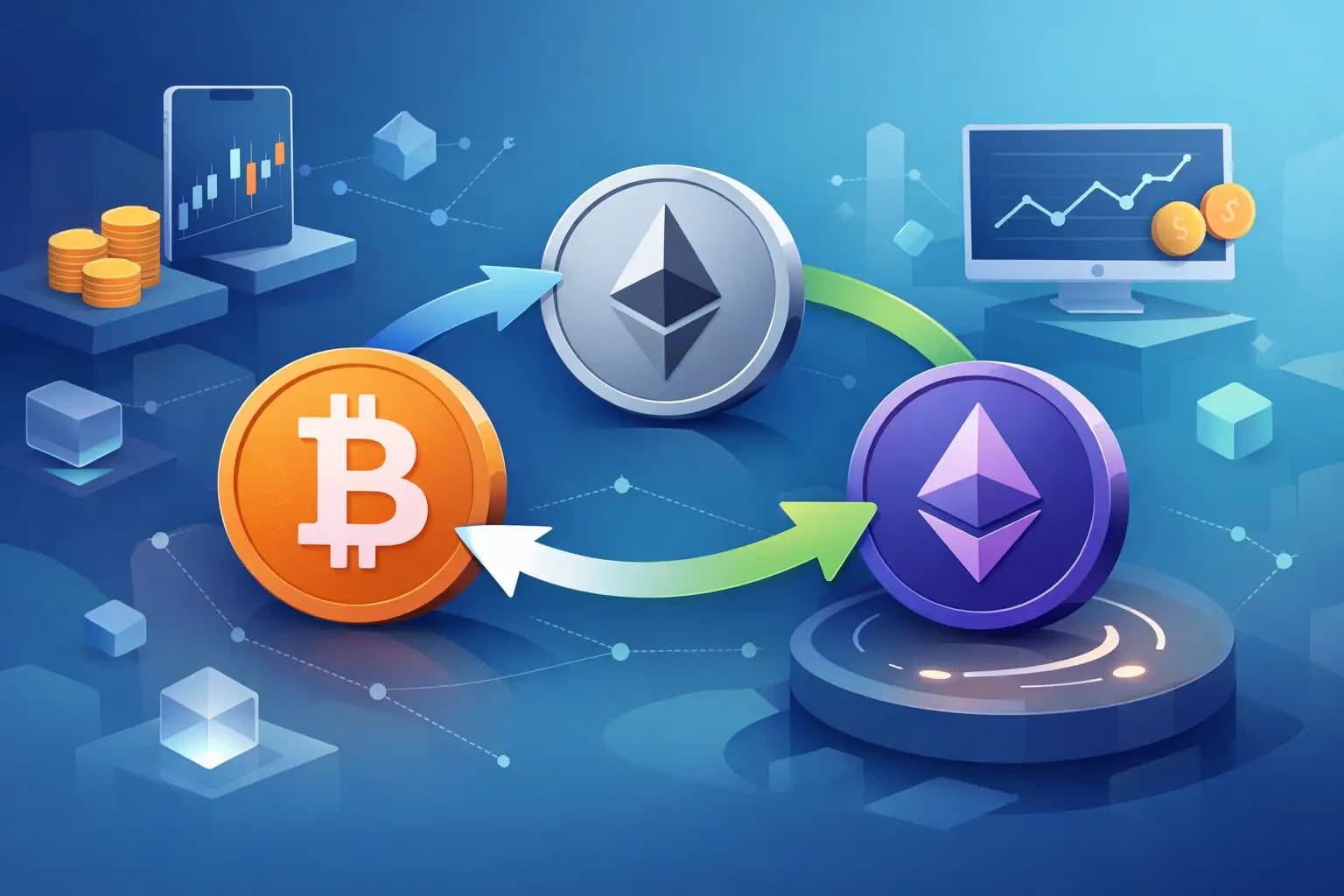
A bad swap usually looks fine at the start. The quoted rate seems acceptable, the asset pair is supported, and the transfer goes out. Then the result lands short because the route was thin, the bridge leg was slow, or fees stacked up across multiple hops. That is exactly why a crypto swap routing guide matters. Routing decides how your trade moves from asset A to asset B, which liquidity sources get used, how many steps sit in the middle, and what you actually receive at the end.
If you move funds often, routing is not a background detail. It is the execution layer. For traders, arbitrage users, treasury operators, and anyone managing self-custodied assets, better routing can mean tighter pricing, fewer failed swaps, and more predictable settlement. It can also mean the opposite when the route is poorly chosen.
What swap routing actually does
At the simplest level, routing is the path your swap takes through available liquidity. Sometimes that path is direct - USDT to BTC, one provider, one conversion. Sometimes it is indirect - one asset gets converted into an intermediate asset, then bridged or swapped again before the final payout reaches your destination wallet.
That path is usually determined by an engine, not by guesswork. The engine checks available pairs, network availability, provider pricing, liquidity depth, and operational constraints. It may split the route across services or favor a provider that can settle faster with less slippage. The best route is not always the shortest one. It is the one that gives the best usable result after fees, spread, timing, and execution risk are all counted.
For users, this changes the way you should look at quotes. The displayed rate is only one part of execution quality. The route behind that quote is what tells you whether the trade is practical.
Crypto swap routing guide: what affects your outcome
The biggest factor is liquidity depth. If a pair is heavily traded and supported across several venues, routing has options. If the pair is thin or sits on a less active chain, the engine may need to use intermediate conversions. More steps can still produce a better outcome, but each extra hop adds another place where cost or delay can appear.
Network choice matters just as much. Swapping USDT on Ethereum is not the same operationally as swapping USDT on TRON or BNB Chain. Fees, confirmation times, congestion, and provider support all vary. A route that looks efficient on paper can become expensive if the source or destination network is busy.
Then there is asset behavior. Stablecoin-to-stablecoin swaps are usually straightforward. Volatile asset pairs are more sensitive to market movement during execution. If the quote window is short and the market is moving quickly, the route has less room for delay. In those cases, speed is part of price quality.
Finally, provider coverage changes the game. A platform that routes across multiple execution partners can compare more paths than a single-source service. That does not guarantee a better outcome every time, but it creates more room to optimize for rate, speed, and pair availability.
Direct route versus multi-hop route
A direct route feels cleaner, and sometimes it is. Fewer moving parts usually means fewer failure points. If there is strong liquidity on the exact pair and network combination you need, direct routing is often the best call.
But direct is not automatically cheaper. A multi-hop route can beat a direct one when the direct market is thin or priced wide. For example, converting through a deeper intermediary asset may reduce spread enough to offset the extra step. This is common when one side of the trade has broad stablecoin liquidity but weaker direct pair support.
The trade-off is operational exposure. More hops mean more timing risk, more fee components, and more status points to track. If you need certainty and speed over squeezing out a marginally better quote, a simpler route may be the better choice.
Cross-chain routing is where mistakes get expensive
Cross-chain swaps introduce another layer because the route is not just a market path. It is also an infrastructure path. The engine has to account for the source network, destination network, token standard, wallet compatibility, and bridge or settlement logic in between.
This is where users often underestimate friction. A route can fail even when the asset pair is technically supported if the destination memo format is wrong, the selected network does not match the receiving wallet, or the route depends on a chain experiencing delays. Good routing is not only about finding liquidity. It is about fitting the full operational path.
That is why visibility matters. If you are sending value across chains, you need to know what stage the transaction is in and whether the delay is happening on-chain, at provider confirmation, or during the final payout. Tracking reduces guesswork. It also helps you decide when a delay is normal and when it needs attention.
A practical crypto swap routing guide for active users
Before you start a swap, define the real objective. If your goal is simply to convert one asset to another, the best route may be different than if your goal is to fund a wallet on a specific network quickly. The desired end state matters more than the pair alone.
Next, check the network context. Confirm that the source wallet can send on the correct chain and that the receiving wallet supports the exact destination asset and network. A good route cannot fix a mismatch at the wallet level.
Then look at execution quality, not just the top-line quote. Ask three practical questions: how many steps are involved, what fees are embedded in the route, and how sensitive is the trade to timing? If the route is complex and the market is moving, a slightly worse quote with faster execution may be the safer option.
For larger sizes, routing quality matters more because slippage compounds. A route that works fine for a small swap may produce a weaker result at scale. If you move size regularly, treat swap routing as part of operations, not a one-off convenience.
It also helps to use platforms built around orchestration rather than a single execution pipe. When a service is designed to route across partners and expose transaction status clearly, you get a more controllable process. That fits how active crypto users actually work - fast decisions, self-custody, and no patience for blind handoffs. This is where a utility layer like 2AML fits naturally: the value is not custody, but routing logic, visibility, and simpler transaction handling.
Common routing trade-offs to watch
The first trade-off is rate versus speed. The best quoted output may rely on a path that takes longer to settle. If you are repositioning funds for an active trade, waiting may cost more than the price improvement saves.
The second is simplicity versus optimization. A multi-step route can improve output, but it also creates more operational dependency. For routine conversions, that may be fine. For time-sensitive movement or high-stakes settlement, fewer steps often win.
The third is privacy versus transparency. Some users want minimal friction and clear transaction progress at every stage. Others prioritize discretion in how funds move. Those goals can coexist, but not every service is designed around both. You need to know which problem you are solving before choosing the route environment.
What a good routing experience should feel like
You should be able to start quickly, verify the route context, and monitor progress without chasing support for basic status updates. The process should make the execution path legible enough to trust, even if the back-end logic is complex.
That does not mean every swap will be instant or every route will be direct. Markets move, chains stall, and some asset combinations simply require more infrastructure. What matters is whether the service handles those realities cleanly. Good routing is not flashy. It is quiet, efficient, and predictable.
For crypto-native users, that predictability is the product. You are not handing over custody. You are choosing an execution layer that can convert assets, manage route complexity, and keep you informed while the transaction moves.
The next time a quote looks attractive, pause for a second and think past the number. Ask what path is being used, what risks sit inside it, and whether the route matches your actual objective. Better swaps usually start with better routing, and better routing starts with paying attention to the path, not just the promise.