

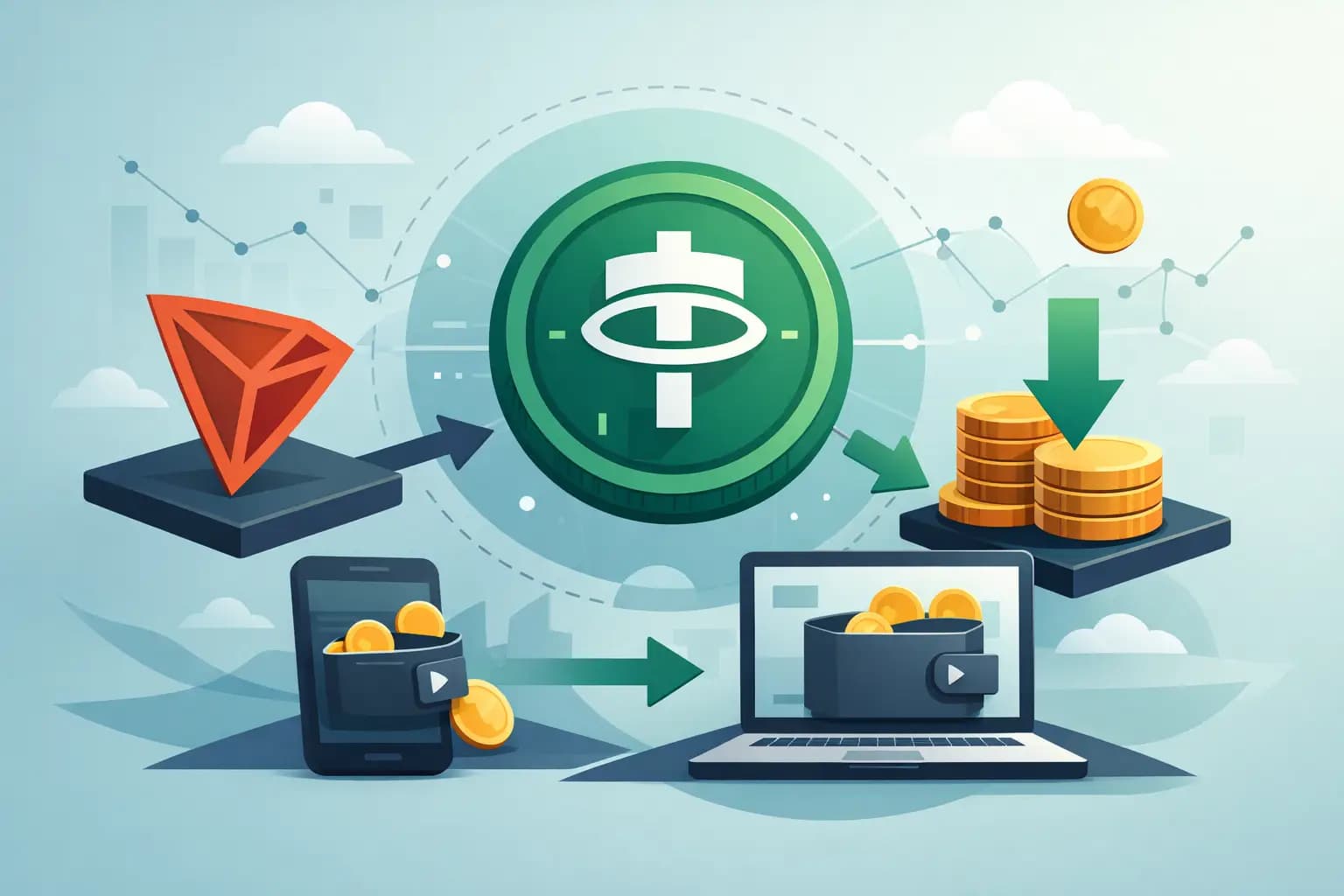
If you move USDT on TRON often, fee spikes are not just annoying - they break workflow. The fastest way to reduce USDT TRON fees is usually not switching wallets or hunting for a cheaper exchange. It is understanding how TRON charges for TRC20 transfers, then using the right resource setup before you send.
For active users, the problem is rarely the sticker price of a single transaction. It is repeated cost leakage. A few extra dollars on each USDT transfer adds up fast if you are paying vendors, rotating balances, arbitraging spreads, or moving funds between platforms. TRON can still be efficient, but only if you treat fees as an operational input instead of a random network tax.
Why USDT transfers on TRON can still feel expensive
TRON has a reputation for low-cost transfers, and compared with some networks, that reputation is fair. But TRC20 USDT is a smart contract token, not a simple native TRX transfer. That matters because smart contract execution consumes network resources, especially Energy.
When your wallet has enough network resources, your out-of-pocket cost can stay very low. When it does not, the network burns TRX to cover the gap. That is where users get surprised. They see TRON advertised as cheap, then pay more than expected because the wallet sending USDT had no Energy available.
Bandwidth also plays a role, but for most TRC20 USDT sends, Energy is the resource that decides whether the transaction is cheap or irritatingly expensive. If you send occasionally, you may not notice the pattern. If you send often, you definitely will.
The main lever to reduce USDT TRON fees
If your goal is to reduce USDT TRON fees consistently, focus on Energy first.
On TRON, Energy is consumed when interacting with smart contracts such as the USDT contract. You can get access to Energy in a few ways. The traditional route is freezing or staking TRX. That works, but it ties up capital. If you need liquidity elsewhere, locking TRX just to support transfers may not be the best trade.
The more practical option for many users is Energy rental. Instead of holding a larger TRX balance and freezing it, you rent the Energy needed for your transactions. For frequent senders, this can be materially cheaper than paying the full burn cost transaction by transaction. It also gives you better cost visibility before execution, which matters when you are managing multiple wallet actions in a day.
This is where operational tooling matters more than theory. A clean Energy rental flow lets you provision resources for the wallet that will actually send the USDT, avoid overfunding with TRX, and execute with fewer pricing surprises.
Why Energy rental often beats paying direct burn fees
Paying direct network burn is simple, but simple is not always efficient. You are effectively accepting the default cost of contract execution at send time. That may be fine for one-off transfers. It is rarely optimal for repeated use.
Energy rental shifts the model. Instead of letting the network charge your wallet at the moment of execution, you source the resource in advance. For active traders, payment operators, and self-custody users, that usually means lower average transfer cost and more predictable spend.
The trade-off is that you need to plan one step ahead. If you rent too little Energy, you can still fall back into burn fees. If you rent too much for infrequent usage, some efficiency is lost. The right setup depends on your transfer volume, timing, and whether your wallets are dedicated to one function or used more broadly.
How to reduce USDT TRON fees in practice
The cheapest transaction is usually the one prepared properly. That means looking at the sender wallet, not just the destination, and making sure the account has what it needs before you hit send.
1. Send from a wallet with Energy available
This sounds obvious, but many users fund a fresh wallet with USDT and forget the resource layer. The wallet can hold USDT and still fail to send efficiently because it lacks Energy or enough TRX to cover fallback costs.
Before sending, check whether the exact wallet initiating the TRC20 transfer has sufficient Energy. If not, either stake TRX, rent Energy, or move funds into a wallet already provisioned for TRON token activity. The sender wallet is what matters.
2. Avoid treating TRX balance as your only fee strategy
Keeping extra TRX in the wallet can prevent failed transactions, but it is not always the cheapest method. A loose rule many users follow is topping up TRX whenever fees become a problem. That works operationally, yet it often hides inefficient spending because the wallet keeps burning TRX rather than using cheaper pre-arranged resources.
A TRX balance is useful as a safety buffer. It should not automatically be your primary cost-control method.
3. Use Energy rental for repeat transfers
If you send USDT on TRON more than occasionally, Energy rental is usually worth evaluating. It is especially useful for users who batch withdrawals, settle with counterparties, or move funds between services on a routine schedule.
Instead of tying up capital in frozen TRX, you can source Energy as needed and align cost more closely with transaction volume. For operational users, that creates a cleaner fee model. You know what resource you are buying and why.
4. Separate your transfer wallets by function
One common source of fee confusion is using the same wallet for everything. If one wallet handles trading withdrawals, private transfers, random token approvals, and USDT settlements, resource usage gets messy fast.
A dedicated TRON payout wallet is easier to provision correctly. You can estimate Energy demand better, monitor actual costs, and avoid cross-activity noise. This is a simple workflow change, but it usually improves fee control.
Mistakes that keep fees higher than they should be
The biggest mistake is assuming every TRON transaction should cost the same. Native TRX transfers and TRC20 USDT transfers are not the same operation. If you compare them directly, your fee expectations will be wrong from the start.
Another mistake is funding only the token amount. A wallet with 100 USDT and zero practical network resources is not really ready to send 100 USDT efficiently. It may still send, but the cost basis will be worse than expected or the transaction may stall until the wallet gets TRX support.
There is also the habit of fixing fee problems after the fact. Users often send first, notice the burn cost, then look for an optimization method. By then, the expensive part already happened. On TRON, the cheapest execution usually comes from pre-transaction setup.
When staking TRX makes more sense than renting
Energy rental is not always the right answer. If you move USDT daily from the same wallet, and your transaction volume is stable, staking or freezing TRX can make sense. The economics improve when your usage is consistent enough to justify the locked capital.
The trade-off is flexibility. Staked TRX is not as liquid for other strategies, and not every user wants to maintain that inventory just to support token transfers. For occasional or variable usage, rental is often cleaner. For steady, predictable throughput, staking may win.
This is one of those areas where it depends on your operating style. The right choice is the one that lowers total cost without creating friction somewhere else.
What active users should optimize first
If you are sending a few times per month, keep it simple. Make sure the sender wallet has enough TRX as backup and look into Energy rental when direct costs start to become noticeable.
If you are sending daily or across multiple wallets, build a process. Standardize which wallet sends USDT, provision that wallet with Energy before transfer windows, and stop relying on ad hoc TRX top-ups as your fee plan. That is where most avoidable cost sits.
For users who want speed and visibility, an interface that handles TRON Energy orders alongside other transaction utilities can reduce switching friction. 2AML fits that operational model by keeping execution tasks in one place instead of forcing users to piece together separate tools for every step.
A better way to think about TRON fees
Trying to reduce fees one transaction at a time is the slow way. The better approach is to design your sending workflow so the wallet is ready before funds move. On TRON, fees are not just a network condition. They are often a preparation problem.
Once you treat Energy like a resource to manage instead of a surprise charge to absorb, USDT transfers get more predictable. And predictable is usually what saves money over time.