

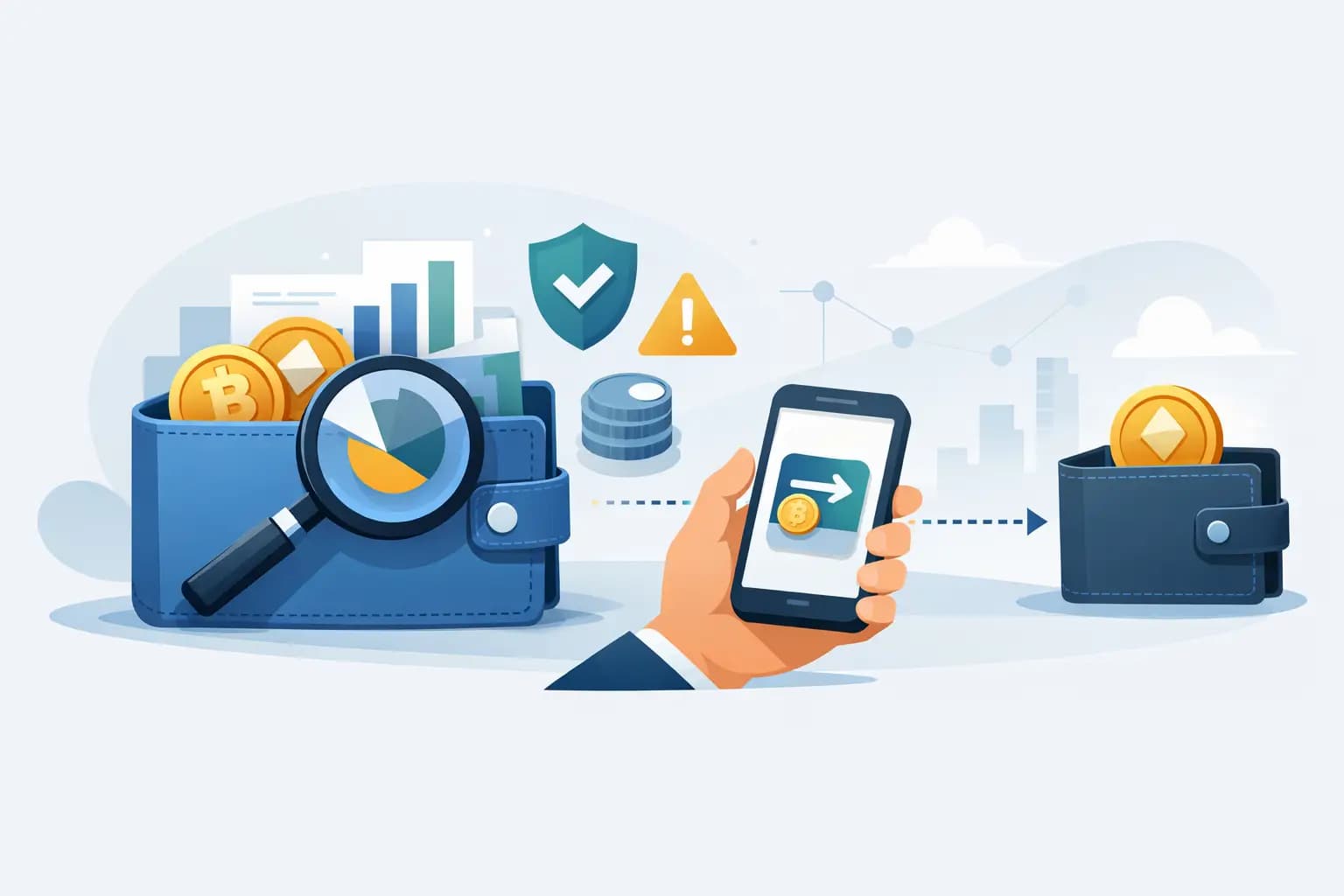
A wallet can look ordinary at first glance and still carry transaction history that changes the risk of receiving funds from it. Knowing how to review wallet exposure gives you a practical control point before a swap, payout, OTC settlement, or vendor transfer. The goal is not to label every unfamiliar address as risky. It is to identify meaningful connections, decide what they mean in context, and act before a transaction creates avoidable friction.
What wallet exposure actually means
Wallet exposure describes a wallet’s on-chain relationship to addresses, entities, or activity categories associated with risk. That relationship may be direct, such as receiving funds from a known sanctioned address, or indirect, such as receiving funds that passed through a high-risk service several hops earlier.
Exposure is not a verdict. Blockchains record movement, not intent. A wallet may receive funds from an exchange, a payment processor, a customer, a smart contract, or an address it does not control. The review is about measuring proximity, amount, timing, and pattern rather than reacting to one data point.
For an active crypto operator, the practical question is simple: if you accept, send to, or interact with this wallet, what operational risk are you taking on? That can include a counterparty dispute, a delayed settlement, a compliance escalation, or a future restriction at a platform you use.
Start with the correct wallet and network
A clean review begins with accurate input. Copy the complete public address directly from the transaction request or your approved counterparty record. Do not rely on shortened addresses, screenshots, or a name attached to an address in a chat.
Then confirm the network. The same-looking address format can exist across multiple networks, particularly for EVM-compatible chains. A review of an Ethereum address is not automatically a review of activity on BNB Smart Chain, Polygon, Arbitrum, or another network. Check the chain where the funds will move and any chains that matter to the counterparty relationship.
For contract interactions, distinguish between the wallet initiating the transaction, the token contract, and the contract receiving funds. Reviewing the wrong address is an easy way to create false confidence.
Review the exposure signals that matter
A useful screening result should show more than a single risk label. Look at the categories behind the score and ask what activity is driving it. The most relevant signals generally fall into four areas:
- Direct exposure to sanctioned entities, stolen funds, scams, ransomware, terrorist financing, or other clearly prohibited activity.
- Exposure to high-risk services or infrastructure, including mixers, darknet markets, unlicensed exchanges, or fraud-related payment flows.
- Transaction patterns, such as rapid pass-through behavior, repeated splitting and consolidation, unusual volume, or chains of newly created wallets.
- Entity attribution and confidence, including whether an address is connected to a known exchange, merchant, bridge, DeFi protocol, or an unverified cluster.
Direct exposure deserves the highest level of attention. If an address has sent or received funds directly from a clearly identified prohibited source, do not treat a low total amount as automatically harmless. The correct next step depends on your policies, jurisdiction, and transaction purpose, but it normally requires escalation rather than a quick approval.
Indirect exposure needs more interpretation. A wallet that received a small amount from a large exchange may appear several hops away from a higher-risk source that also used that exchange. That does not mean the wallet participated in the underlying activity. The closer the connection, the more recent it is, and the larger the share of funds involved, the more material it becomes.
How to review wallet exposure in context
A risk score is a starting point, not a decision engine. To review wallet exposure properly, compare the result with the planned transaction and the wallet’s broader behavior.
Start with transaction value. A minor historical exposure may carry a different operational weight than an exposure linked to most of the wallet’s current balance. Then check recency. Activity from years ago can still matter, especially for severe categories, but recent transactions often provide a more relevant picture of current risk.
Next, consider the direction of funds. Did the wallet receive from a risky source, send to it, or merely share an indirect route through common infrastructure? A direct outgoing payment to a high-risk service can indicate a different relationship than a small inbound transfer from an unknown sender.
Finally, assess the commercial or personal explanation. A frequent customer payment, an OTC settlement, a treasury rebalance, and a one-off wallet purchase do not have identical risk profiles. If the counterparty can provide a clear source-of-funds explanation that matches the on-chain timeline, that context may resolve uncertainty. If the explanation is vague, changes over time, or conflicts with visible activity, treat that as a separate signal.
Check patterns, not isolated transactions
Single transfers can be misleading. Wallet reviews become more reliable when you inspect the pattern around them.
Look for whether funds move quickly through the address with little balance retention. This pass-through behavior is not automatically suspicious - payment wallets and trading operations can behave the same way - but it deserves closer attention when combined with high-risk counterparties or complex routing.
Also look for concentration. If nearly all incoming value comes from one source, that source matters more than a long list of tiny unrelated transactions. If the wallet repeatedly receives funds from multiple newly funded addresses and consolidates them immediately, investigate the purpose of that structure.
Bridges and decentralized protocols require care. A bridge transaction can break the visible path between networks, while smart contract activity can make a straightforward payment appear complex. Do not assume complexity equals wrongdoing. Instead, determine whether the route makes sense for the wallet’s stated activity and whether the exposure continues after funds arrive on the destination chain.
Set clear decision thresholds before volume increases
Fast operations need repeatable rules. Define what triggers approval, a request for more information, enhanced review, or rejection. Without thresholds, every screening result becomes an improvised debate and slows down legitimate transactions.
Your thresholds should account for risk category, exposure level, transaction size, frequency, and counterparty type. A small one-time payment may justify a different review process than recurring vendor settlements or a large treasury movement. Severe direct exposure should never be normalized because a transfer is urgent.
A practical workflow may look like this: screen the wallet before initiating the transaction, record the result and date, review the identified exposure, compare it with the transaction context, and document the action taken. If the result requires escalation, pause the transaction until the review is complete. If it is acceptable, proceed while retaining a record that the check occurred.
Avoid the two common review mistakes
The first mistake is overreacting to any exposure. Public blockchains are interconnected. Funds routinely pass through exchanges, market makers, bridges, and DeFi contracts used by thousands of unrelated people. A distant connection alone does not establish intent, ownership, or liability.
The second mistake is treating a low score as a permanent green light. Scores can change as new addresses are attributed, new illicit activity is identified, or a wallet begins operating differently. Screen close to the time of the transaction, especially for larger transfers and new counterparties.
False positives and incomplete attribution are real trade-offs in on-chain analysis. Use the result as an operational control, not as a substitute for judgment. For material transactions, confirm details through your own counterparty process and preserve the evidence behind the decision.
Keep an audit trail that is actually useful
You do not need a complicated case file for every routine transfer, but you do need a record that another person can understand later. Capture the wallet address, network, screening date, risk result, relevant exposure category, transaction amount, transaction purpose, and disposition.
If you approve a wallet with moderate or indirect exposure, note why. For example, the exposure may be old, low-value, several hops removed, or explained by activity through a recognized exchange or protocol. If you decline or pause a transaction, record the specific signal that triggered the decision rather than writing only “high risk.”
This discipline improves consistency as transaction volume grows. It also lets you identify repeat counterparties that have been reviewed successfully, while ensuring they are rechecked when the value, route, or behavior changes.
Make screening part of transaction setup
Wallet screening works best when it happens before funds are committed, not after a transaction is already pending. Build the review into the same pre-send routine as confirming the address, network, asset, and amount.
For users who move across services and networks, a dedicated AML wallet check can reduce the time spent switching between tools and manually interpreting incomplete data. 2AML is designed to keep that step visible alongside other digital asset operations, so you can review an address, make a decision, and continue with a clearer transaction record.
The useful outcome is not a perfect prediction of every counterparty. It is a better decision at the moment it matters: before funds leave your wallet, while you still control the next step.