

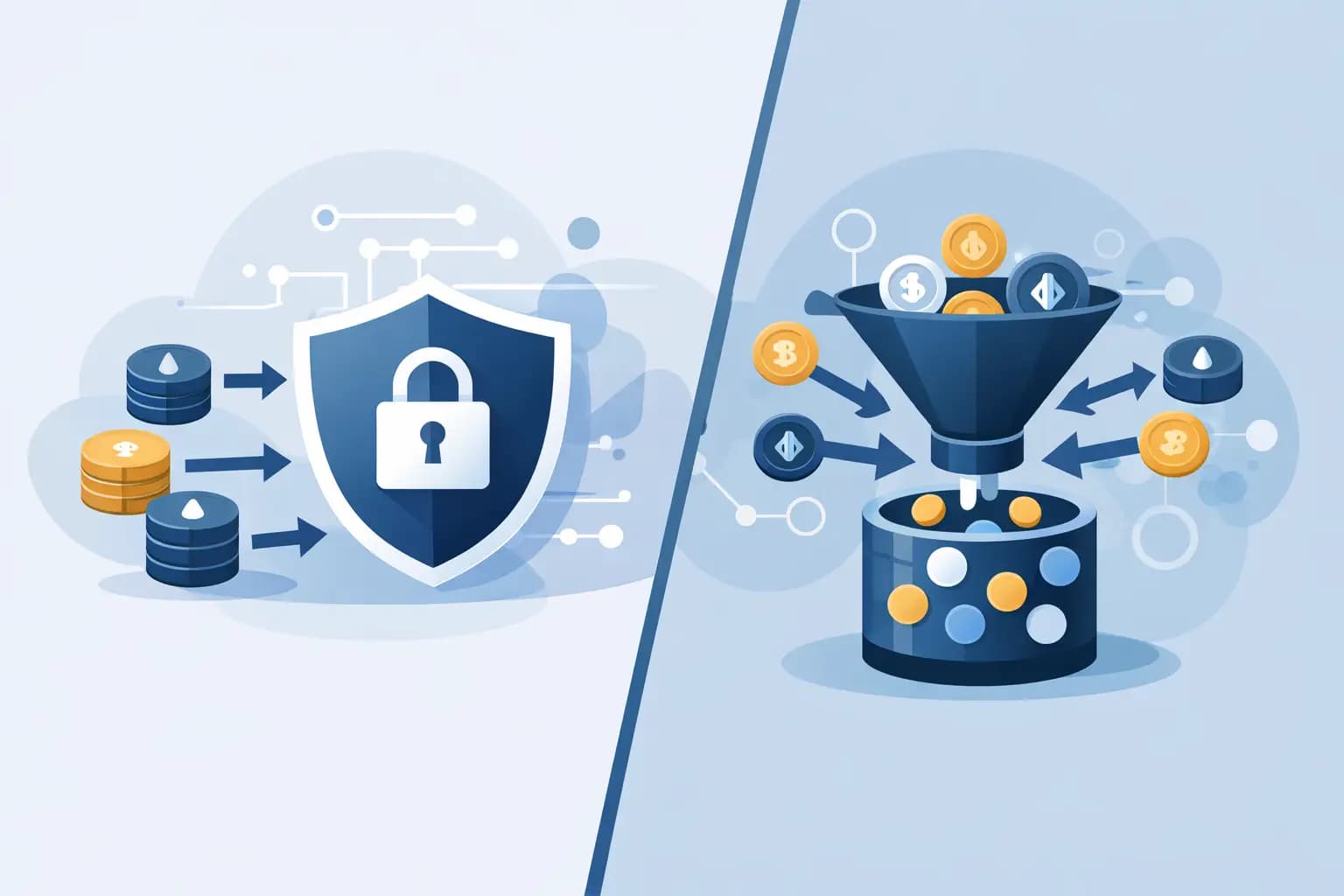
If you move crypto often, the difference between private send vs mixer is not academic. It affects execution speed, traceability of the process, the amount of trust you hand over, and how much visibility you keep while funds are in motion. For active users, that difference matters more than labels.
The problem is that these terms often get grouped together as if they describe the same thing. They do not. A mixer usually refers to a pooling model where funds from multiple users are blended together before output distribution. Private send, in a modern product context, usually refers to a guided transaction flow built to reduce direct wallet-to-wallet linkage while preserving a cleaner user experience, clearer routing, and more predictable execution. That distinction changes the risk profile.
Private send vs mixer: the operational difference
A mixer is generally understood as a service that combines incoming funds from many participants and redistributes them in a way that makes transaction tracing more difficult. That can create a stronger break in visible transaction relationships, but it also introduces obvious trade-offs. You are often relying on a third-party process you cannot fully inspect, timing can vary, and output behavior may depend on pool liquidity, batching logic, or service-specific rules.
Private send flows are usually framed differently. Instead of presenting the service as a blind pool, they are often designed as an execution layer that routes a transaction through a predefined privacy-oriented process. The key point is not just privacy. It is operational clarity. Users want to know what they are doing, what stage the transaction is in, and when to expect completion.
That is where the real split appears. In a mixer model, opacity is often part of the mechanism. In a private send model, the user experience can be more transparent even while the transaction path is designed to reduce straightforward linkage.
Why the distinction matters in real use
If you are a casual observer, both options may look like privacy tools. If you are actually sending size, handling frequent wallet operations, or trying to keep workflows clean, the details matter fast.
The first issue is custody and control. Many mixer services historically required a level of blind trust that active crypto users no longer accept. You send assets in, wait, and hope the service behaves as expected. If there is a delay, limited status information, or route failure, you are left with very little to work from. For users who care about execution, that is a weak operating model.
The second issue is transaction visibility. Privacy does not have to mean losing insight into the process. In fact, many users want the opposite. They want fewer obvious wallet links on-chain, but more visibility into the service flow itself. They want to see that the transaction was received, routed, processed, and completed. That is a very different expectation than older mixer-style systems where the mechanism was intentionally vague from the user side.
The third issue is friction. A service can claim privacy, but if the process is slow, confusing, or overloaded with extra steps, it does not fit real trading or treasury behavior. Crypto users moving between wallets, chains, exchanges, DeFi protocols, and payment endpoints need something practical. They do not want a process that turns a simple transfer into an open-ended wait.
Where mixers still appeal to some users
It is worth being direct here. Some users still look at mixers because the concept is easy to understand. Pool funds, break direct transaction relationships, receive output later. For someone focused on one narrow outcome, that can sound simple.
But simple at the concept level is not always simple in practice. Mixer-based services can create uncertainty around delays, pool sufficiency, output timing, and service reliability. They may also produce a workflow that is hard to monitor in real time. If your only decision factor is whether a service claims to obscure transaction history, a mixer may still appear attractive. If your decision includes speed, process clarity, and reduced operational ambiguity, the answer can change.
This is why private send vs mixer should be framed as a workflow decision, not just a privacy decision.
How to evaluate private send vs mixer for your use case
Start with the kind of transaction you are making. If you are handling occasional low-priority transfers and are willing to accept uncertainty in timing, your tolerance for opaque processing may be higher. If you are moving funds as part of active operations, that tolerance usually drops.
Next, look at how much process visibility you get. Can you track each stage, or are you just waiting for an output? Does the service clarify routing behavior, expected completion windows, and transaction states? If not, you are operating with less control than you probably think.
Then consider the trust model. Are you using a utility layer that focuses on execution and routing, or are you sending funds into a black box and hoping for the right result? Crypto-native users have become much more selective here. The more often someone moves assets, the less patience they have for vague service mechanics.
Finally, think about how the privacy function fits into the rest of your stack. A privacy-oriented transfer is rarely the only thing happening. You may also need to swap assets, review wallet exposure, or manage network costs on chains like TRON. If your privacy tool forces you to leave one environment and rebuild your workflow elsewhere, the friction adds up.
Private send vs mixer in a product-led environment
This is where newer infrastructure-focused platforms have an advantage. Instead of treating privacy as a standalone black box, they present it as one step inside a broader transaction workflow. That means faster starts, less confusion, and clearer execution status.
For the user, the benefit is practical. You are not choosing between privacy and usability. You are choosing a transaction flow that can support both. If a platform lets you initiate quickly, monitor progress, and maintain a clearer view of the route without adding unnecessary account friction, it aligns better with how active crypto users actually operate.
That model also fits self-custody behavior better. Users want utility, not ceremony. They want to move assets with less exposure, but they do not want to sacrifice every operational safeguard just to do it.
A platform like 2AML reflects that shift by treating private-send execution as part of a wider utility stack rather than a standalone mystery box. That matters because the best privacy-related flow is usually the one that works predictably, not the one that sounds the most obscure.
Common mistakes when comparing the two
One mistake is assuming more opacity always means more effective privacy. That is not necessarily true. Sometimes opacity just means worse user information. A service can be vague without being better.
Another mistake is ignoring speed and route clarity. If your funds are in motion and you cannot tell what stage they are in, you are carrying more operational risk. That may be acceptable for some users, but many discover too late that they value visibility more than they expected.
A third mistake is comparing only on branding. Some services use privacy-heavy language to make different mechanisms sound interchangeable. They are not interchangeable if one gives you real-time status and the other gives you silence.
Which option makes more sense?
It depends on what you optimize for. If you want a legacy-style privacy mechanism and are comfortable with a more opaque service model, a mixer may still match your expectations. If you want a cleaner transaction experience with lower friction, better process visibility, and a routing model built for active use, private send is often the stronger fit.
That is especially true for users who do not operate in isolation. Traders, freelancers paid in crypto, OTC-style operators, and small digital asset businesses usually need privacy-aware movement without breaking the rest of their workflow. They need something they can start quickly and monitor without guessing.
The better question is not which term sounds stronger. It is which service model gives you the balance of privacy, speed, control, and transparency you actually need.
When you compare private send vs mixer through that lens, the answer becomes less about ideology and more about execution. And in crypto operations, execution is usually what decides whether a tool is useful after the first transaction.