

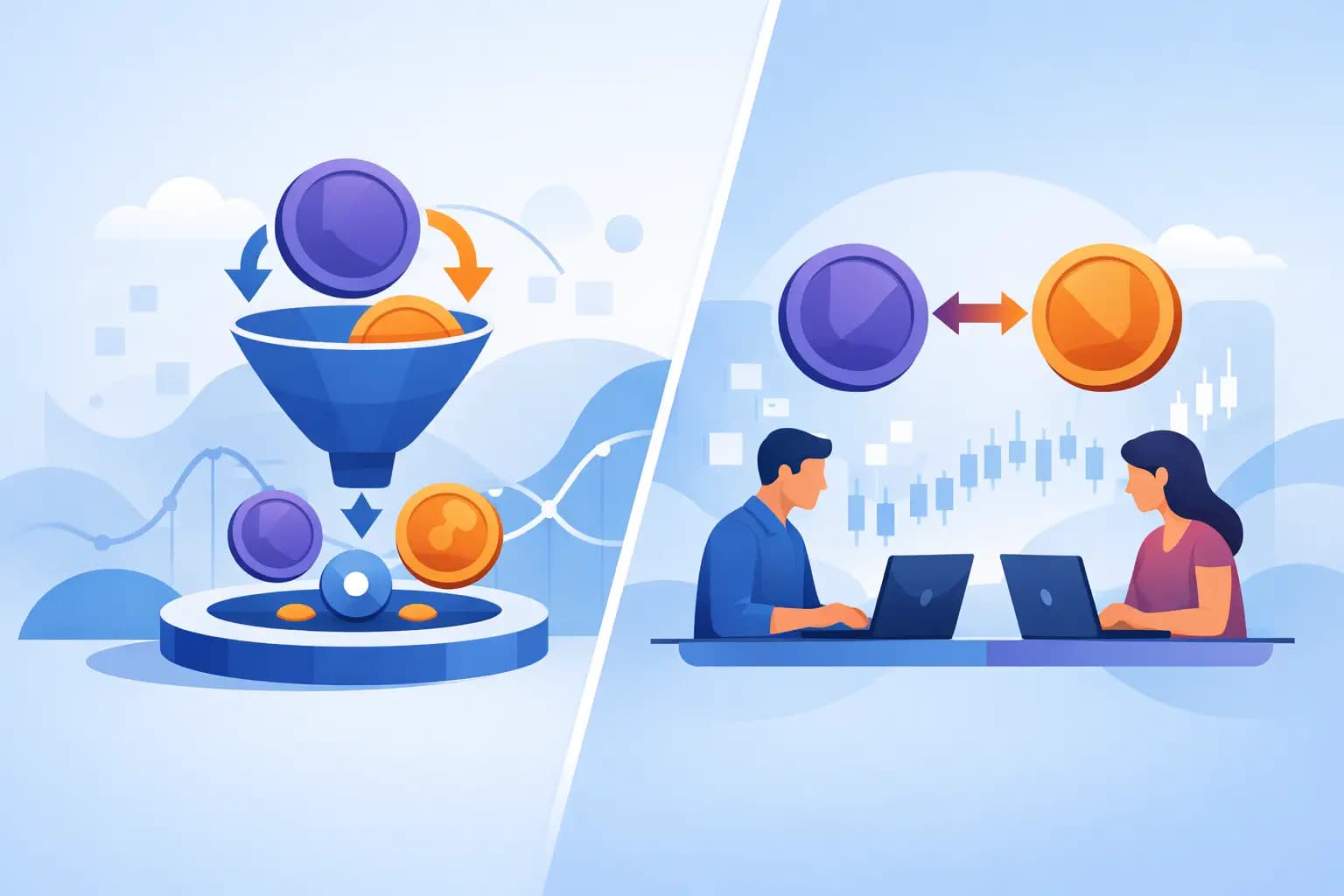
A swap that looks simple at the wallet level can take very different paths behind the quote. In the swap aggregator versus direct exchange decision, the real question is not which option sounds better. It is whether you need the best available route across multiple providers or prefer to execute through one known venue with a defined process.
For active crypto users, that choice affects the rate you receive, how quickly a transaction completes, how much information you can verify before sending, and what happens when market conditions change mid-swap. The right route depends on the asset pair, network, transaction size, and your need for operational control.
What a swap aggregator does
A swap aggregator compares available routes from multiple liquidity sources or exchange partners. Instead of sending every request to one provider, it evaluates quotes and can select the route that best matches the requested pair and amount.
This matters when liquidity is fragmented. One provider may offer a stronger BTC-to-USDT rate, while another may handle a smaller altcoin pair more efficiently. An aggregator reduces the work of checking each option manually. You enter the assets, amount, and destination address, then receive a quote based on the routes available at that moment.
The best route is not always the route with the highest displayed output. A useful routing layer also considers whether the provider can process the requested amount, whether the selected network is supported, expected execution time, provider limits, and the chance that a quote will need to be refreshed. For users moving between wallets or networks regularly, this can remove a large amount of repetitive operational work.
An aggregator is especially practical when you value optionality. You are not relying on a single venue to have competitive liquidity for every transaction. If one provider has limited capacity, another route may still be available.
How a direct exchange works
A direct exchange sends the transaction through one exchange or liquidity provider. The quote, rules, processing flow, and available pairs are tied to that provider's inventory and execution model.
There is nothing inherently inferior about this approach. Direct execution can be the better option when you already know a provider performs well for a specific pair, when you prefer its interface or settlement process, or when a particular route has consistently met your timing requirements.
It can also make the transaction path easier to predict. You know who is processing the swap, what limits apply, and where to review the provider's stated conditions. For repeat workflows using the same asset pair and similar amounts, that consistency can be valuable.
The trade-off is reduced choice at the moment of execution. A direct provider may have a good rate, but you generally will not know whether another source could complete the same swap with better pricing or a faster route unless you compare separately.
Swap aggregator versus direct exchange: the practical differences
The difference becomes clearer when a transaction is evaluated as a workflow rather than just a price quote.
Rate and total output
A direct exchange gives you one provider's rate. An aggregator can compare multiple available rates and present a route selected for the transaction. That often creates an advantage for pairs with uneven liquidity, but it is not a guarantee that every aggregated quote will beat every direct quote.
Compare the final amount you are expected to receive, not only the headline exchange rate. Network fees, provider fees, minimums, and price movement during processing can change the effective result. A slightly lower displayed rate may still lead to a better outcome if the route has lower total costs or more reliable execution.
Liquidity and asset availability
Direct providers have their own supported assets and capacity. If a provider does not support a token, network, or requested amount, the transaction cannot proceed through that route.
Aggregators can broaden available options by connecting users to multiple partners. This is useful for cross-asset conversions, less common tokens, and situations where one provider's liquidity is temporarily constrained. Still, availability changes constantly. A route visible for a small test amount may not remain available for a larger transfer.
Execution time
Fast execution depends on more than the exchange itself. Blockchain confirmations, network congestion, partner processing, destination-chain conditions, and compliance checks can all add time.
An aggregator can route around a provider with slower conditions when another supported partner is available. A direct exchange can be just as fast when its route is well supplied and its processing queue is clear. The practical advantage comes from visibility: check the estimated processing conditions before sending, then track the transaction after it starts.
Control and transparency
Direct exchange gives you a straightforward provider relationship. An aggregator gives you routing flexibility. Neither removes the need to verify the transaction details yourself.
Before confirming any swap, check the send asset, receive asset, network, deposit address, expected output, minimum amount, and destination address. A good operational interface should make these details easy to review and should provide transaction status updates after funds are sent.
For a non-custodial workflow, control also means keeping custody of your wallet and private keys. You authorize the on-chain send from your own wallet, while the service coordinates the requested conversion and payout. That structure can suit users who want execution support without placing an ongoing balance on a centralized platform.
Privacy, screening, and transaction readiness
Privacy and risk management are not the same thing, but both affect how confidently you can move funds. Some users need discreet transaction flows. Others need to check a wallet's AML risk exposure before accepting funds, making a payment, or routing assets into a business workflow.
Treat these as separate operational decisions. A wallet screening result can help identify exposure that may create friction with a counterparty or service provider. It does not guarantee future acceptance or replace your own compliance obligations. Likewise, a private-send flow should be used responsibly and with a clear understanding of the rules that apply to you.
A platform such as 2AML is designed around this kind of utility stack: swap routing, transaction visibility, wallet AML checks, and TRON energy support can sit within one operational environment instead of requiring separate tools for each task.
When an aggregator is usually the stronger choice
Choose an aggregator when you are comparing a wide range of pairs, moving across supported networks, or executing transactions where the available liquidity may differ significantly by provider. It is also useful when speed matters but you do not want to manually request quotes from multiple services.
It can be a particularly efficient choice for freelancers receiving crypto payments, DeFi users rebalancing between assets, arbitrage participants responding to short-lived conditions, and small operators handling varied client or treasury flows. The value is not just price discovery. It is reducing the number of decisions and tabs required to complete a transaction correctly.
Use a small test transaction first when you are sending to a new destination, using an unfamiliar network, or working with an asset that has strict memo, tag, or contract-address requirements. Routing technology can improve execution options, but it cannot correct an incorrect recipient address.
When direct exchange makes more sense
A direct exchange can be the more practical route when you have already validated a provider for the exact pair and amount you use. It may also fit transactions with provider-specific benefits, known processing expectations, or fixed operational requirements.
For example, an OTC-style operator may prefer a familiar direct route for repeat conversions because historical performance matters more than checking every available source. A trader executing a common pair at a known venue may also choose direct execution when the quote is competitive and the provider's conditions are clear.
The key is to avoid treating familiarity as proof of the best current outcome. Markets, liquidity, and network conditions change. Reassess the route when the amount, asset pair, or chain changes.
A better way to choose each time
Start with the transaction objective. If you need broad route comparison, variable-pair support, and less manual work, an aggregator is usually the logical first option. If you need a known provider path for a repeat workflow, direct exchange may be the cleaner choice.
Then verify the details that can actually change your result: the final expected output, all network selections, provider limits, estimated timing, and the status-tracking process. If a transaction is time-sensitive, build room for confirmation delays instead of assuming a quoted estimate is a guarantee.
The best execution path is the one that gives you a clear quote, a supported route, and enough visibility to act without guessing. Make the choice transaction by transaction, keep custody of your wallet, and confirm every address before funds leave it.