

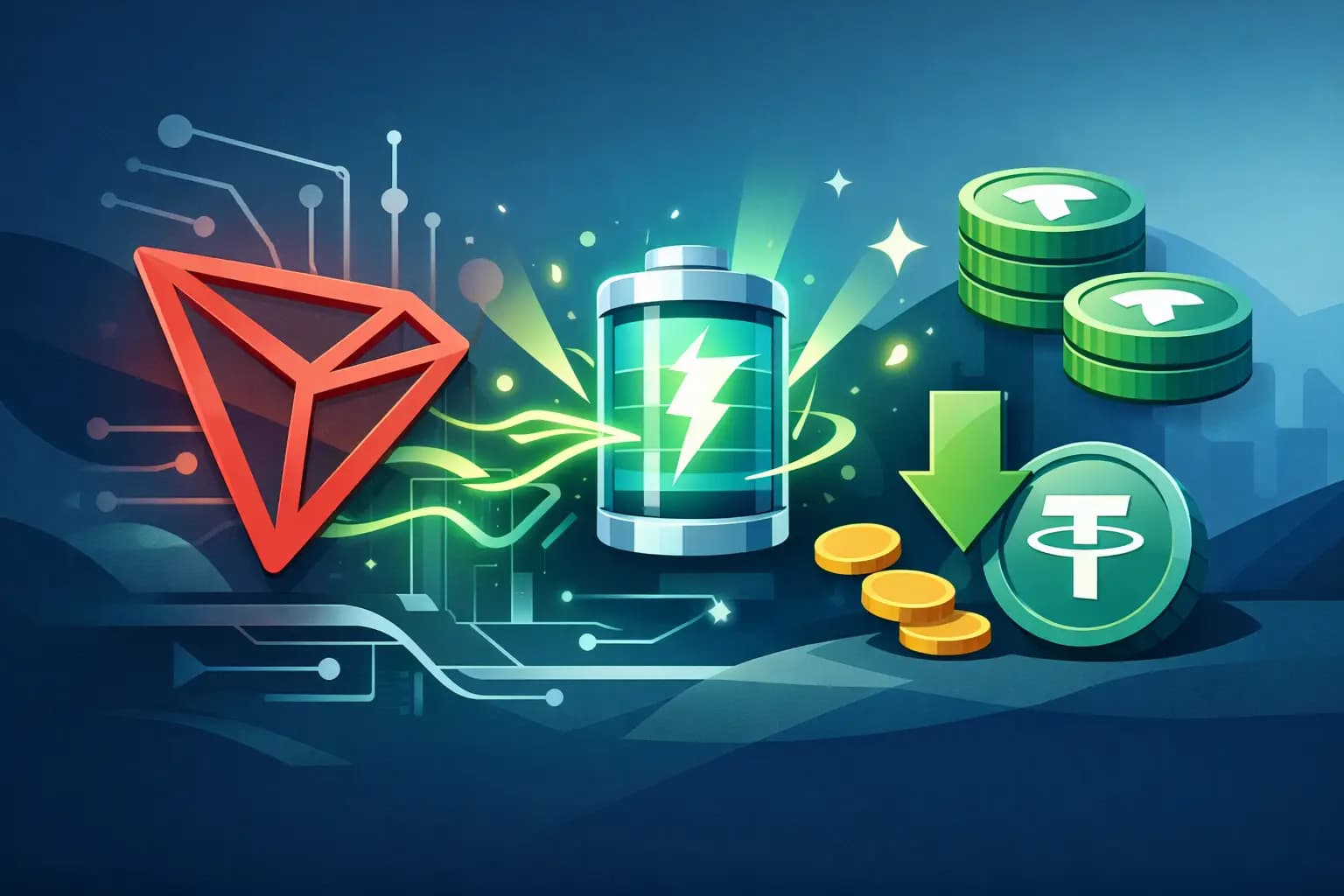
If you move USDT on TRON often, you have probably seen the same problem more than once: one wallet sends fine, another stalls, and a third burns more TRX than expected. That usually comes down to tron energy - the network resource that pays for smart contract execution on TRON.
For active users, this is not a small detail. It affects transfer costs, wallet readiness, and whether a payment goes out on the first try. If you are sending TRC20 USDT, managing payout flows, or moving funds across multiple wallets, understanding how tron energy works can save both time and margin.
What TRON energy actually does
TRON uses a resource model instead of a simple flat gas fee model. Two resources matter most: bandwidth and energy. Bandwidth covers basic transaction data. Energy is used when a transaction interacts with a smart contract.
That distinction matters because TRC20 USDT transfers are smart contract calls. Even if all you are doing is sending stablecoins from one address to another, the transfer still consumes energy. If your wallet does not have enough, the network makes up the difference by burning TRX.
In practical terms, energy is what stands between a low-cost USDT transfer and a higher-than-expected fee. The more often you send, the more valuable it becomes to manage that resource instead of paying the default cost every time.
Why USDT on TRON depends on energy
A standard TRX transfer is relatively simple. A USDT transfer on TRON is not. It calls the token contract, updates balances, and records the state change on-chain. That contract execution is what consumes energy.
This is why users sometimes get confused when they have enough USDT in the wallet but still cannot send. The wallet may be short on TRX for fallback fees, or it may not have enough energy allocated. The token balance alone is not enough.
For occasional users, paying the fee in burned TRX may be fine. For anyone sending repeatedly, that approach gets expensive fast. At that point, renting energy often becomes the more efficient move.
How tron energy is obtained
There are two main ways to get tron energy. You can freeze TRX on the network and receive resources over time, or you can rent energy for a shorter period.
Freezing TRX makes sense if you hold a steady TRX balance and regularly operate from the same wallets. It is a capital allocation decision. Your TRX is tied up for a period, and the economics only work if your usage is consistent enough to justify it.
Renting is usually better when usage is variable, when you do not want to lock capital, or when you need energy now. That is why it has become common among traders, payout operators, and users who send TRC20 USDT in bursts rather than on a fixed schedule.
Neither approach is universally better. It depends on transaction volume, treasury preferences, and how much operational flexibility you need.
When renting energy makes more sense
If you are sending USDT a few times per month, manual fees may be tolerable. Once you are sending daily, across multiple addresses, or in time-sensitive windows, fee predictability starts to matter more than convenience.
Renting energy is often the better choice in four situations. First, when you need to reduce per-transfer cost. Second, when you want to avoid holding excess TRX just to cover contract execution. Third, when you operate across several wallets and want a cleaner workflow. Fourth, when failed or delayed transfers create real friction for your business or trading activity.
This is especially true for users who handle recurring payouts, arbitrage flows, OTC settlements, or wallet rotation. In those cases, energy is less of a technical concept and more of an operating input.
The trade-off between freezing and renting
Freezing can be cheaper over a long enough time horizon, but only if your assumptions hold. You need stable usage, enough TRX to lock up, and the patience to manage resource allocation yourself.
Renting costs money upfront, but it buys flexibility. You can size energy based on actual demand and avoid parking capital in TRX. That can be the better operational decision even if the theoretical unit cost is slightly higher in some periods.
There is also a control factor. Users who actively manage multiple wallets often prefer predictable procurement over estimating how much frozen energy each address will need. A slightly higher direct cost can still be worth it if it reduces failed sends, manual top-ups, and monitoring overhead.
Common mistakes users make with TRON fees
The most common mistake is assuming a USDT balance is enough to send USDT. It is not. The wallet needs the resources to execute the contract.
The second mistake is keeping just enough TRX for one transfer and hoping fees stay consistent. They do not always. Resource consumption can vary, and a wallet that worked yesterday may come up short today.
The third mistake is treating energy as a one-wallet problem. If you operate several addresses, resource planning becomes a workflow issue. One underfunded wallet can slow down a batch, a client payment, or a trading sequence.
The fourth mistake is optimizing only for headline price. Cheap energy is not useful if delivery is slow, visibility is poor, or the process adds more manual work than it removes.
How to think about tron energy operationally
If you are an active user, the right question is not just what energy costs. The better question is how much friction it removes.
A good energy workflow should let you estimate what a wallet needs, place an order quickly, and track status without guessing. That matters more when timing matters. If you are waiting on confirmations, balancing exchange windows, or trying to keep payout operations moving, extra clicks and uncertainty become their own cost.
That is where infrastructure matters. A useful service layer does not just source energy. It makes the process visible and predictable, especially for users who are already managing swaps, wallet checks, and transaction routing elsewhere.
What to look for in a TRON energy service
Speed matters, but speed alone is not enough. You also want clear order flow, transparent status, and enough structure to avoid avoidable mistakes.
At minimum, the process should make it obvious which wallet receives the resource, what quantity is being ordered, and when the allocation is expected. If the service leaves too much ambiguity around delivery or order state, the workflow breaks down fast.
This is one reason integrated utility platforms are useful for active crypto users. If you already handle swaps, screening, or other transaction tasks in the same environment, adding TRON energy there can reduce context switching. 2AML fits that model by treating energy rental as part of a broader transaction operations stack rather than as a standalone tool.
Is tron energy worth it for smaller users?
Sometimes yes, sometimes no. If your usage is light and irregular, renting energy for every transfer may be unnecessary. You may be better off keeping a small TRX buffer and accepting occasional fee burn.
But smaller users still benefit when one transaction matters. If a payment is time-sensitive, if a wallet cannot fail, or if you simply want fee control before moving a larger amount of USDT, securing energy ahead of time can be the cleaner choice.
The break-even point is not only about volume. It is also about how much you value certainty.
A practical way to decide
Start with your actual sending pattern. If you move TRC20 USDT often, calculate what you spend in burned TRX over a week or month. Then compare that with the cost of renting energy for the same period or transaction volume.
Next, look at how much time you spend managing wallet readiness. If you are topping up TRX manually, checking balances before every send, or troubleshooting avoidable failures, you are already paying an operational tax even before the network fee hits.
That is usually the point where tron energy stops being a niche optimization and becomes part of a cleaner transaction setup. For active wallets, the goal is not just lower fees. It is fewer interruptions, better cost control, and less guesswork every time USDT needs to move.
The simplest setup is the one that keeps your transfers moving without making you think about them twice.