

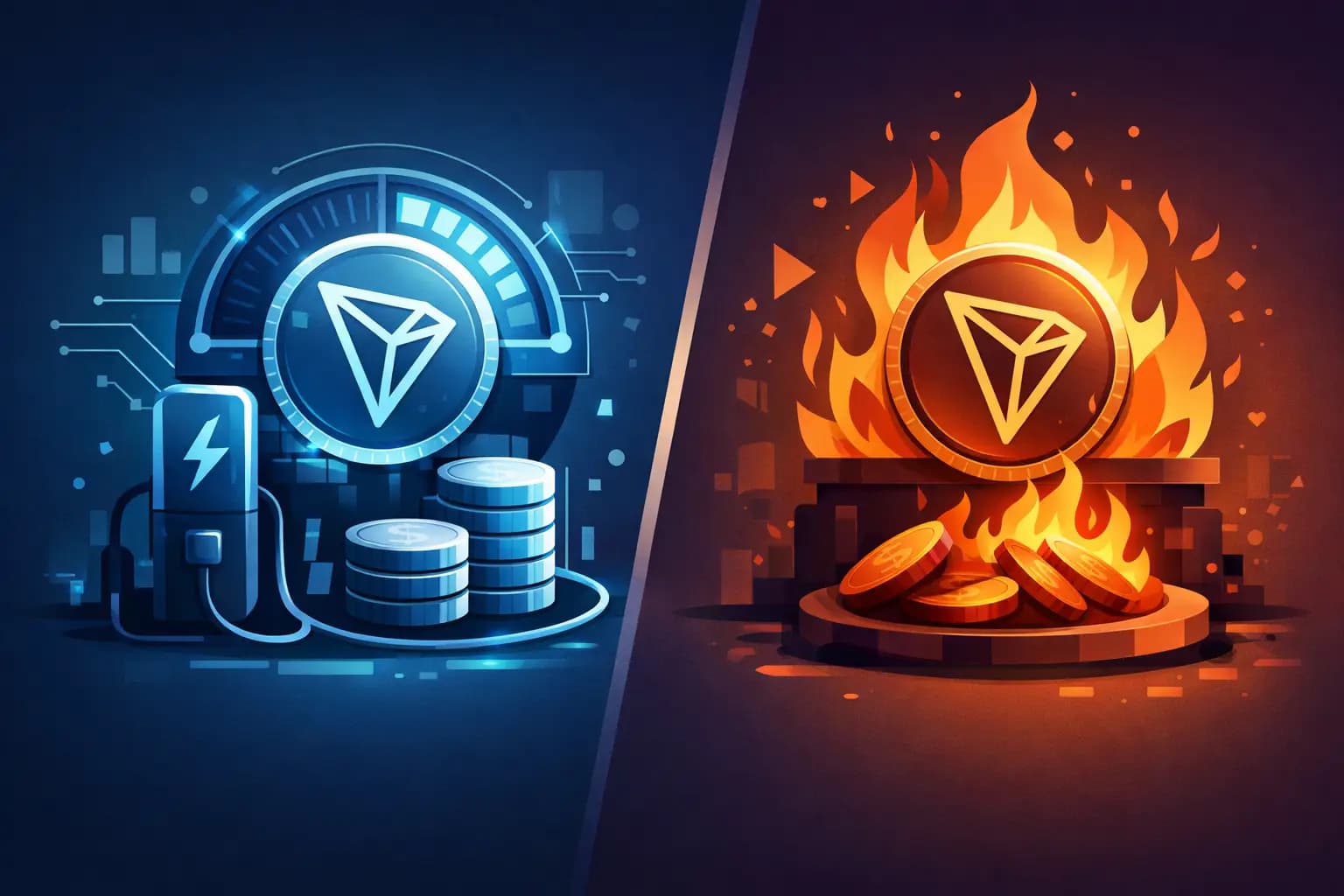
A single TRON USDT transfer can look cheap right up until it hits a wallet with no Energy. Then the network starts burning TRX, fees jump, and what should have been a routine send turns into cost leakage. That is why tron energy rental vs burning matters for anyone moving USDT, settling client payouts, or running repetitive contract activity on TRON.
If you only send occasionally, burning may be fine. If you move volume, need predictable execution cost, or manage multiple wallets, rental usually gives you more control. The real decision is not which method is better in theory. It is which method fits your transaction pattern with the least friction.
How TRON fees actually work
TRON uses network resources rather than a simple flat gas model. The two resources most users care about are Bandwidth and Energy. Bandwidth helps cover basic transaction data. Energy is consumed when interacting with smart contracts, which includes TRC-20 USDT transfers.
If your wallet has enough available Energy, the contract call can execute with little or no TRX burned. If it does not, TRON falls back to burning TRX to complete the transaction. That fallback is convenient, but convenience and cost efficiency are not the same thing.
This is where many users misread their fee exposure. They assume TRON is always cheap because the base network is known for low costs. In practice, contract execution cost depends on whether your wallet has resources ready when the transaction is sent.
TRON energy rental vs burning: the core difference
Energy rental means acquiring temporary Energy from a third-party provider instead of locking your own TRX or paying burn fees at execution time. Burning means letting the network charge the wallet in TRX when available Energy is insufficient.
Operationally, rental is a planning tool. Burning is a fallback mechanism.
That distinction matters more than the definitions themselves. If you know a wallet will send USDT repeatedly over the next few hours or days, renting Energy before execution can lower transaction cost and make spend more predictable. If you are sending one transaction from a wallet you rarely use, burning may be the fastest path because there is nothing to arrange in advance.
The choice is really about frequency, timing, and cost visibility.
When burning makes sense
Burning is not a mistake. In some workflows, it is the cleanest option.
If you send TRC-20 tokens once in a while, the overhead of sourcing rental may not be worth the savings. The same applies when the amount being moved is large enough that a modest TRX fee is operationally irrelevant. Some users also prefer burning when they need immediate execution from a wallet that was not prepared in advance.
There is also a simplicity advantage. No separate Energy order, no need to estimate usage, no timing around rental windows. You send the transaction, the network charges what is required, and the transfer completes if the wallet holds enough TRX.
That said, burning becomes inefficient fast when it turns into a habit rather than an exception. What feels easy on one transfer often becomes expensive over dozens or hundreds.
When energy rental usually wins
Rental is built for repetition. If you are paying vendors in USDT, moving funds between treasury wallets, settling OTC flow, or batching client transfers, the economics shift quickly in favor of rented Energy.
The biggest benefit is fee control. Instead of exposing each transaction to burn costs, you provision Energy ahead of time and execute against that resource. This makes cost per transfer easier to forecast and easier to manage across multiple wallets.
There is also a workflow benefit. Pre-funded Energy reduces the chance that a transfer stalls because the wallet has insufficient TRX available for burn. For operators moving funds on a schedule, that reliability matters as much as raw savings.
For active users, tron energy rental vs burning is less about theory and more about whether you want transaction costs to be reactive or planned.
The trade-off most users overlook
Rental is often cheaper, but it is not magic. You still need to match the order to actual usage.
If you overbuy Energy for a wallet that ends up idle, some of that cost efficiency disappears. If you underbuy, the wallet can still fall back to burning. Timing matters too. Energy is useful when it is available before execution, not after the transaction has already been sent.
Burning has the opposite profile. It is inefficient per transaction in many cases, but it is perfectly aligned with sporadic use because you only pay when you transact. No planning, no estimation, no idle resource.
So the right answer depends on whether your pain point is high per-transfer cost or operational overhead. For high-frequency senders, burn fees usually hurt more. For low-frequency senders, management overhead may matter more than optimization.
Cost predictability matters more than average cost
A lot of users compare rental and burning only on headline savings. That is useful, but incomplete.
For anyone running a repeatable process, predictability is often the bigger advantage. Burning introduces variability because the wallet fee depends on available resources at the moment of execution. If several wallets are active and balances are moving constantly, that uncertainty creates small but recurring mistakes. One wallet is ready, another is not, and your actual transaction cost drifts higher than expected.
Rental creates a cleaner operational state. You know which wallet has Energy, for how long, and roughly how many transfers that resource should support. That makes it easier to route transactions deliberately instead of reacting to fee surprises after the fact.
This matters for traders and arbitrage users, but it also matters for freelancers, payroll-style senders, and small businesses that do not want fee management to become a daily task.
How to choose the right option for your flow
The easiest way to decide is to stop thinking in single transactions and look at behavior over time.
If a wallet sends TRC-20 USDT only occasionally, burning is usually acceptable. If the same wallet sends several times per day or serves as part of a repeated payout flow, rental will usually be more efficient. If you manage several wallets, rental becomes even more useful because you can provision resources where they are actually needed rather than leaving execution costs to chance.
You should also factor in urgency. If a transaction must go out right now and no Energy is available, burning may be the practical choice. If you have a few minutes to prepare and expect continued activity, rental is usually the better setup.
A simple rule works for most users: burn for exceptions, rent for patterns.
TRON energy rental vs burning for USDT senders
USDT on TRON is where this decision becomes most visible because the volume is constant and the transaction type is common. Wallets used for payroll, exchange transfers, merchant settlements, affiliate payouts, and internal treasury moves can burn through TRX surprisingly fast when every send relies on fallback fees.
With rental, those same wallets can execute in a more controlled way. You are not changing the asset or the network. You are changing how the transaction resource is supplied.
That is especially useful if you care about keeping operational wallets lean. Instead of holding excess TRX in every address just to cover uncertain burn fees, you can provision Energy as needed and keep the wallet setup cleaner.
For users who already prefer self-directed flows and clear transaction visibility, that model tends to fit better than constantly topping up TRX for fee coverage.
Where a platform helps
Energy optimization gets annoying when it lives in a separate tab from the rest of your transaction workflow. If you are screening wallets, swapping assets, and moving USDT across networks, fragmented tools create delays and blind spots.
That is why some operators use a utility layer that keeps routing, transaction support, and TRON Energy ordering closer together. 2AML is one example of that approach. The value is not custody. It is reducing steps and giving users a clearer way to prepare transactions before fees turn into a problem.
For active TRON users, that kind of setup is less about convenience branding and more about execution discipline.
The practical answer on tron energy rental vs burning is simple: if you are sending rarely, burn and move on. If you are sending often, rent early and keep your transaction flow predictable. The cheaper option is the one that matches how you actually operate.