

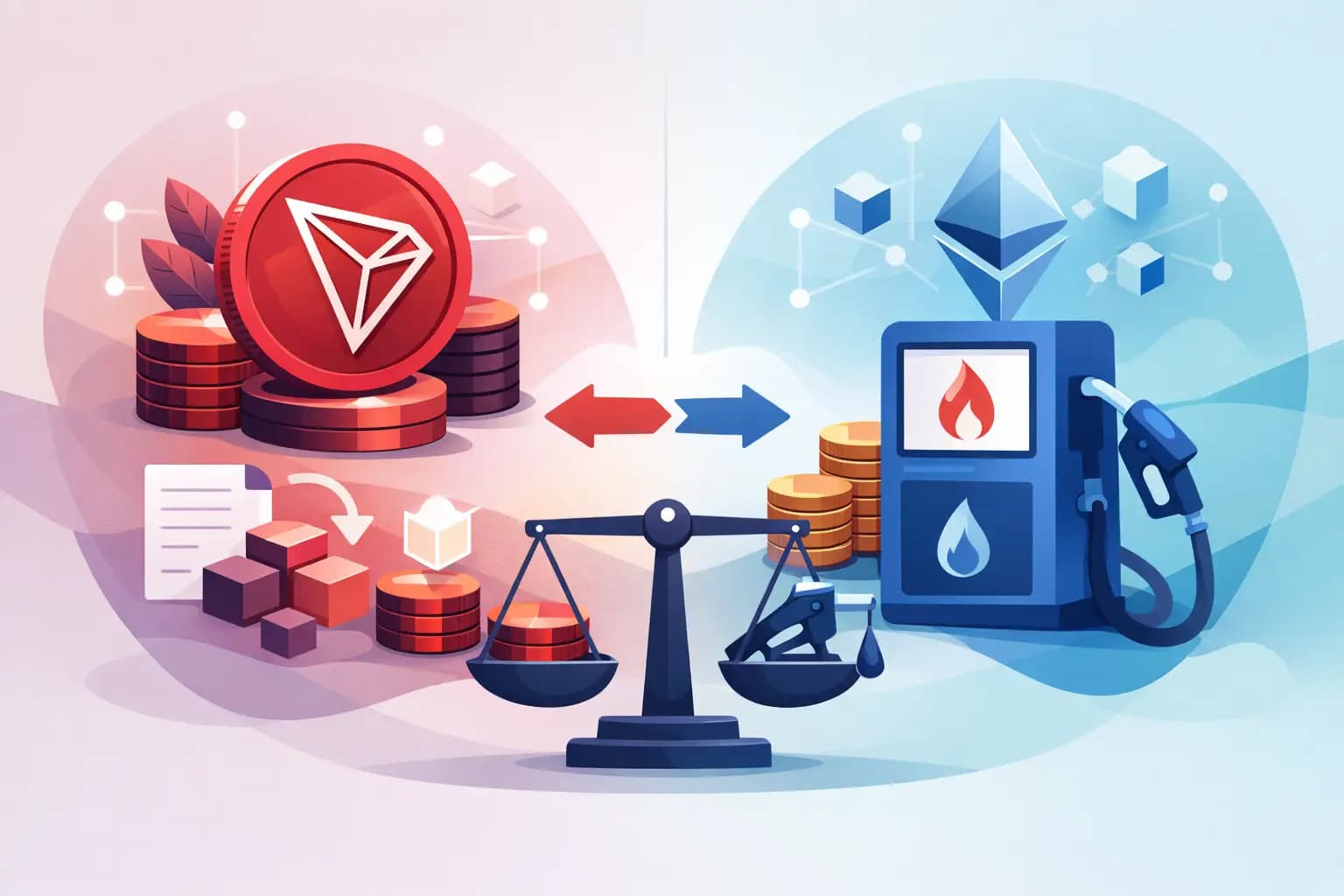
A TRC20 transfer can look cheap right up until the wallet asks for more TRX than expected. That is the practical difference behind TRON resource leasing versus gas fees: one approach prepares transaction resources before execution, while the other pays the network at the moment it needs them.
For active TRON users, this is not just a terminology question. If you move USDT frequently, settle payouts, rebalance between wallets, or operate a service flow, transaction costs can become less predictable when every smart-contract call burns TRX. Leasing resources can turn part of that variable cost into a planned operational input.
The right choice depends on what you are sending, how often you transact, and whether you need immediate execution or repeatable cost control.
How TRON transaction costs actually work
TRON does not use a single fee category in the same way that many users think about Ethereum gas. Its network transactions consume resources, primarily bandwidth and energy. When your wallet has enough of the required resources, the transaction can execute without burning as much TRX. When it does not, the protocol charges TRX to cover the shortfall.
Bandwidth generally applies to transaction data. A basic TRX transfer may mainly require bandwidth. Smart-contract interactions require more. Sending a TRC20 token such as USDT calls the token contract, which usually consumes energy as well as bandwidth.
That distinction matters because a wallet may display one total fee, but the cost underneath it is resource-based. The amount can vary based on the transaction type, your available balance of resources, and the contract execution required at that time.
Calling this a gas fee is useful shorthand, but it is not the full operational picture. On TRON, the question is often not simply, "How much TRX will this transfer cost?" It is, "Do I have the bandwidth and energy this transaction needs before I submit it?"
What happens when resources are missing
If your account has insufficient bandwidth or energy, TRON can burn TRX to complete the transaction. For an occasional transfer, that is usually the simplest path. Sign the transaction, accept the displayed cost, and move on.
The trade-off is uncertainty. A contract call that costs little in one scenario may cost more in another, especially when you are relying on burned TRX rather than available resources. For a user making one transfer, this may not justify extra setup. For an operator sending many transfers, it can make cost planning harder than it needs to be.
TRON resource leasing versus gas fees: the operational difference
TRON resource leasing, commonly called energy rental, gives an address delegated network resources for a defined period. You pay a provider for access to those resources, then use them from your own wallet when you send a transaction. The provider does not need your private key, and a legitimate resource order should never require your seed phrase.
Paying gas fees, by contrast, means letting the protocol burn TRX when a transaction does not have enough resources available. It is immediate and requires no advance order, but it is a pay-as-needed model.
Think of the difference this way: burning TRX is buying execution at the point of use. Leasing energy is reserving execution capacity before the transaction is broadcast.
Neither is always cheaper. A lease can be efficient when its energy amount and duration match real transaction volume. It can be wasteful when you rent more than you use, rent too early, or select an order that does not cover the resource profile of your transaction. Direct TRX fees may be better when you make rare transfers or need to send immediately without estimating future usage.
When leasing is usually the better fit
Energy leasing becomes more compelling when you regularly interact with TRC20 contracts. This often includes repeated USDT sends, payment batches, treasury movements, wallet-to-wallet settlements, and workflows where the same address executes multiple contract calls within a short period.
It also helps when you want to preserve TRX for other purposes instead of allowing each transfer to draw down your balance unpredictably. Rather than keeping an oversized TRX buffer in every sending wallet, you can arrange resources around the transactions you expect to execute.
For small teams, the benefit is operational clarity. A known resource order is easier to review than a long series of variable fee burns across several addresses. It does not remove the need to check transaction details, but it gives you one more lever for controlling cost.
When paying the fee directly makes more sense
If you send TRON USDT once in a while, direct payment is usually the lowest-friction option. You avoid choosing a lease duration, estimating energy requirements, and monitoring whether the rental remains active.
The same applies to urgent, one-off transactions. If timing matters more than optimizing a small cost difference, paying the displayed fee can be the correct decision. The goal is not to lease resources for every transaction. The goal is to avoid paying for capacity you will not use.
How to choose the right setup before sending
Start with the asset and transaction type. A native TRX transfer and a TRC20 USDT transfer do not have the same resource profile. If you are interacting with a smart contract, expect energy to be part of the equation.
Next, look at transaction frequency. One transfer per month is very different from ten transfers per day. Leasing tends to make more sense as repeat usage rises, particularly when transactions occur within the lease period.
Then check the resources already available to the sending address. An account with staked or delegated energy may need less additional capacity than a fresh wallet with no resources. Do not order based only on a generic estimate from someone else's transaction. Your wallet state and the contract call itself affect the final result.
Finally, leave room for exceptions. Energy may cover the central smart-contract cost, but bandwidth, account-related actions, or a resource shortfall can still affect what happens at execution. Confirm the available resources in your wallet before signing, and keep a reasonable TRX balance for edge cases.
A practical energy-rental workflow
A clean workflow is short. First, identify the exact wallet address that will send the transaction. Resources must be delegated to the sending address, not the recipient address.
Second, select an energy amount and duration based on the transaction you expect to complete. If you are making several USDT sends, size the order for the batch rather than treating each send as an isolated event. If the transfer is truly one-time, compare the lease price against simply paying in TRX.
Third, wait for the delegation to appear, then verify the balance of energy and bandwidth in the wallet before submitting the transaction. Resource delivery is not the same thing as a completed transfer. The transfer still needs to be signed and broadcast from your self-custody wallet.
Fourth, track the result. Confirm the transaction status, review resources consumed, and use that record to improve the next order. After a few repeated flows, you can usually estimate your own resource needs more accurately than any generic calculator can.
Platforms such as 2AML can simplify this process by putting TRON energy orders in the same operational environment as other digital asset utilities. The value is not handing over control of funds. It is reducing tool switching while keeping the resource order, wallet activity, and transaction workflow visible.
Avoid the mistakes that make leasing look expensive
The most common error is renting energy for the wrong wallet. If one address receives the delegation but another address signs the USDT transfer, the resources will not help the transaction you intended to optimize.
Another mistake is assuming energy solves every fee scenario. Energy is central to smart-contract execution, but TRON transactions can still require bandwidth or face other conditions. Check the full resource picture instead of treating an energy order as a universal fee exemption.
Overbuying is equally costly. Longer rental periods and larger allocations only help when the address has consistent use. For a sporadic wallet, paying a direct fee may be cleaner and cheaper.
Finally, protect your wallet credentials. A resource provider needs a public address for delegation. It does not need your private key, recovery phrase, or signing access. Keep signing inside your own wallet and verify the destination address before every order and transfer.
The best cost model is the one that matches your actual transaction rhythm. Pay direct TRX fees when simplicity and immediacy matter. Lease resources when repeated contract activity makes planned capacity more efficient. Start with one real workflow, measure what it consumes, and let your own transaction data determine the next move.