

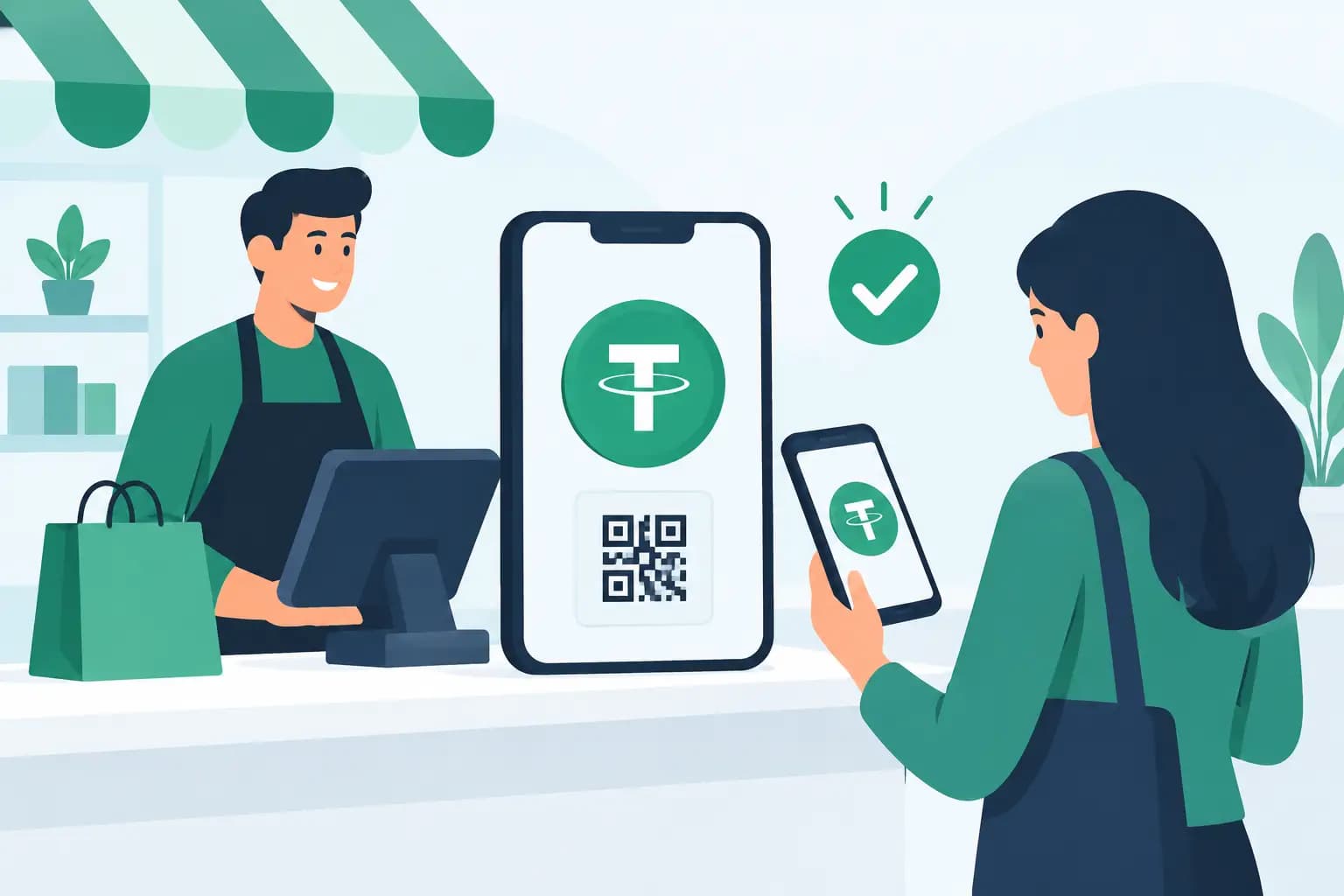
A crypto payment can look simple from the customer side: copy an address, send USDT, wait for confirmation. For the merchant, the real work happens around that transfer. A reliable merchant USDT payment example needs to account for the selected network, an exact payable amount, on-chain confirmation rules, customer status updates, and what happens after funds arrive.
That operational layer matters whether you sell digital services, accept OTC-style invoices, pay contractors, or run a small online business. USDT can reduce settlement delays compared with traditional rails, but it does not remove the need for clear payment logic. A customer who sends USDT on the wrong chain or sends an outdated invoice amount still needs a defined resolution path.
What a merchant USDT payment example should show
The strongest payment flow gives both sides a clear answer to four questions: what asset to send, which network to use, where to send it, and when the order is considered paid. If any of those details are unclear, support volume rises quickly.
Assume a customer is purchasing a $750 digital marketing package. At checkout, the merchant quotes payment in USDT and offers TRON as the payment network. The invoice screen displays the payable amount, a TRON-compatible recipient address, a QR code, the order reference, and a countdown showing how long the quote remains valid.
The customer sends 750 USDT on TRON. The payment system detects the transaction, monitors the required confirmations, and matches the received amount and asset to the open invoice. Once the payment meets the merchant's confirmation policy, the order status changes from "Awaiting payment" to "Paid." The customer sees the transaction ID and confirmation state, while the merchant receives a record tied to the order.
This is the basic flow. The details determine whether it remains reliable under normal volume and edge cases.
Merchant USDT payment example: order to settlement
Start with an invoice created from the merchant's order system. The invoice should have a unique reference, a defined asset, a selected network, an amount, and an expiration time. A short validity window can help when the price originates in dollars and the business needs predictable accounting, though USDT itself is designed to track the dollar.
For this example, the merchant creates invoice 10482 for 750 USDT on TRON. The customer is shown one network only. This matters. Presenting several chains without making the selection unmistakable creates a common failure mode: a user sends USDT through Ethereum, BNB Smart Chain, or another network to an address intended for TRON.
After the customer broadcasts the transaction, the checkout page should move into a pending state. It should not immediately claim success simply because a transaction was detected. Detection confirms that a transaction exists. Settlement status depends on the merchant's chosen confirmation threshold and whether the received transfer matches the invoice conditions.
The system then compares the transfer against the invoice. It checks the receiving address, token contract or asset identity, network, amount, transaction status, and timing. If the customer sent exactly 750 USDT before expiry, the invoice can progress to confirmed payment after the required block confirmations.
At that point, the merchant fulfills the order. For a digital product, access can be issued automatically. For a service invoice, the operations team may receive a paid status and begin delivery. For physical goods, the order can move to fulfillment. The payment event should stay attached to the invoice record so support and accounting teams can trace it later without searching manually through a block explorer.
Build the payment screen around one clear action
A payment screen should reduce decisions, not create more of them. The asset and network need to be visible beside the address itself, not buried in a note below the QR code. Use plain language such as: "Send exactly 750 USDT on TRON only." Include the invoice expiration time and a copy function for the address.
Real-time status also changes the customer experience. A useful sequence is "Waiting for payment," then "Transaction detected," then "Confirming," followed by "Payment complete." This prevents the customer from refreshing the page, submitting duplicate transfers, or assuming an on-chain delay means the payment failed.
For USDT on TRON, customers also need enough TRX or available network resources to complete their transfer. A failed outbound transaction is usually a sender-side issue, but it becomes a merchant support issue when the invoice timer keeps running. Businesses that regularly transact on TRON can reduce operational friction by planning for network resource costs. Tools such as 2AML can help users manage TRON energy rental alongside other digital asset operations.
Set policies before accepting the first payment
USDT acceptance is not just an address-generation task. Merchants should define their payment rules before customers encounter an exception. The policy does not need to be long, but it needs to be enforceable.
Set a minimum and maximum invoice amount if those limits matter to your business. Decide how many confirmations are required before delivery. Low-value digital goods may use a faster policy than high-value orders, where additional confirmations can reduce exposure to chain reorganizations or unconfirmed transaction risk.
Also define how to handle underpayments, overpayments, late payments, and duplicate payments. An underpayment of 0.50 USDT may be easy to resolve manually, while a larger difference may require the customer to send the remainder or request a refund through the merchant's stated process. A late payment may arrive after an invoice has expired and been replaced with a new price or order reference. These are normal operational cases, not rare exceptions.
Wallet and transaction risk review belongs in the policy as well. Depending on the merchant's jurisdiction, customer type, and risk tolerance, a business may need to screen receiving flows or investigate flagged activity before releasing goods or services. Screening is a control layer, not a substitute for a broader compliance program. Keep records of invoice data, transaction identifiers, timestamps, risk decisions, and any customer communication tied to an exception.
Choose the network deliberately
USDT exists on multiple networks, and they are not interchangeable. TRON is often selected for its broad USDT usage and generally lower transfer costs. Ethereum may fit customers and treasury systems already operating in ERC-20 assets, but fees and confirmation economics can differ. Other supported networks may be appropriate for a specific customer base, but each additional option adds testing, monitoring, support, and reconciliation requirements.
For a business starting out, one well-supported network is often better than four loosely managed choices. Add another network only when customer demand, treasury needs, and operational readiness support it. If you do offer multiple options, create a separate invoice route for each one and show the selected chain in every payment status message.
Reconcile payments without losing visibility
A merchant should be able to answer three questions quickly: which invoice was paid, which transaction paid it, and where the funds moved afterward. That requires records beyond a wallet balance.
Match each payment to an internal order ID. Store the network, sender address where available, recipient address, token amount, transaction ID, detection time, confirmation time, and final invoice state. If funds are later consolidated, swapped, or moved to a treasury wallet, retain that operational trail separately from the original customer payment.
The settlement choice depends on the business. Some merchants keep a portion of USDT for expenses or supplier payments. Others convert received funds according to their treasury policy. Neither approach is automatically better. Holding USDT introduces issuer, custody, and policy considerations, while frequent conversion can create costs and additional operational steps.
Avoid the payment failures customers remember
Most avoidable problems come from ambiguity. Do not reuse a vague payment address with no invoice reference for every customer if you need clean automated matching. Do not mark an order complete on transaction detection alone. Do not assume a token called USDT on one network is equivalent to the expected USDT route on another.
Clear notices help, but interface design does more. Place the network name next to the amount. Show the invoice expiration time before the customer sends. Keep the confirmation state visible after the transaction is found. If manual review is required, say so directly rather than leaving the buyer on an indefinite pending screen.
A merchant USDT payment flow works best when it treats the blockchain transfer as one event in a controlled order process. Make the payment instruction exact, track every step in real time, and give exceptions a defined route. Customers get confidence without unnecessary friction, and your team gets a payment operation it can actually run.