
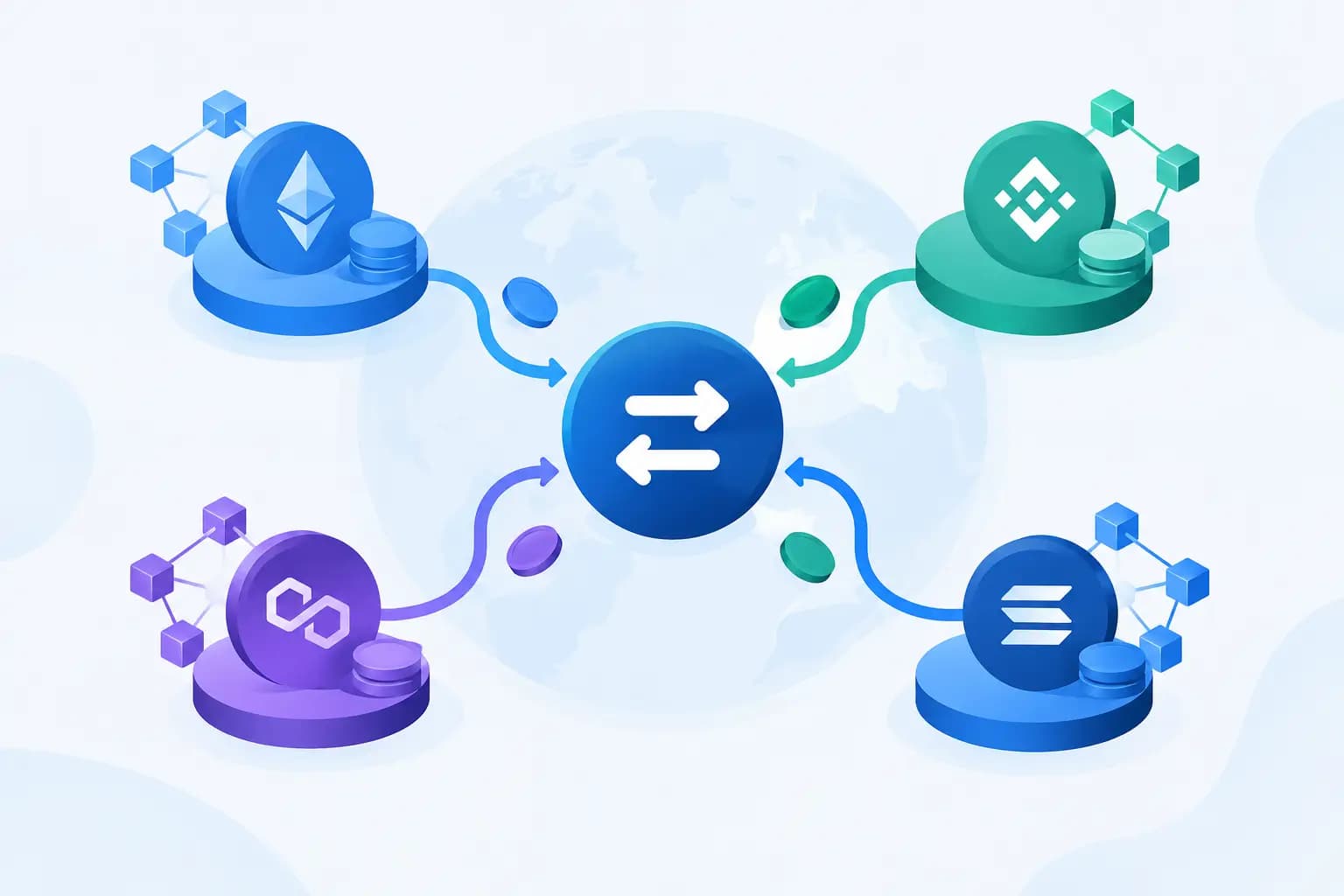
A swap can look complete on the sending wallet and still be operationally unfinished. The asset may be moving through a provider route, waiting on confirmations, converting through an intermediate pair, or headed to an incompatible destination network. This multinetwork swap case study examines that gap between pressing Confirm and having usable funds where they are needed.
The scenario is representative rather than a report of a specific customer transaction. Its purpose is practical: show the decisions that affect a cross-network swap before funds leave a wallet, the visibility needed while the route is active, and the checks that prevent an ordinary conversion from becoming a support problem.
The Multinetwork Swap Case Study
Consider an active trader holding USDC on Ethereum who needs USDT on TRON to settle a time-sensitive payment. The trader controls both wallets, has the receiving TRON address ready, and does not want to keep funds on an exchange just to perform one conversion.
At first glance, the task is simple: send USDC, receive USDT. In reality, it combines two separate actions. The asset must be exchanged, and the value must reach another network in a form the receiving wallet can use. The best route is not automatically the one with the biggest quoted output. It is the route that balances final amount, execution time, available liquidity, network costs, required confirmations, and destination support.
This distinction matters most when the transaction has a deadline. A route that looks cheaper but requires a slower source-chain confirmation window may be the wrong choice for an operator funding a TRON payment, responding to an OTC counterparty, or moving capital between strategies.
The operational objective
The trader's actual objective is not "swap USDC for USDT." It is "receive enough USDT on TRON, at a known address, within an acceptable execution window." Framing the request this way changes the workflow.
The destination network must be selected before the quote is accepted. The receiving address must be valid for that network. The sender must retain enough ETH to pay the source-chain gas fee. And the expected output must be evaluated after route fees and network costs, not against a mid-market price seen elsewhere.
A platform such as 2AML operates as a utility and routing layer in this workflow. It does not need custody of the user's private keys to help present the route, collect the required transaction details, and expose the status of the conversion as it progresses.
What Happens Before the Swap Starts
The most costly errors in multinetwork execution are usually made before the first on-chain transaction. They tend to be input errors, not market errors.
First, the user chooses the exact source asset and source network. USDC is not one interchangeable balance across every chain. USDC on Ethereum, TRON, Solana, and other networks can have different routing options, fee conditions, and confirmation behavior. Selecting the token symbol without confirming the chain is not enough.
Next comes the destination. In this case, the user selects USDT on TRON and enters a TRON-compatible receiving address. A copied address should be reviewed character by character at the beginning and end, then checked against the selected network. Address formats can sometimes look familiar across ecosystems, but a valid-looking address is not proof that it belongs to the intended chain or asset flow.
The quote then provides the operational baseline: the amount to send, the expected amount to receive, the time limit if applicable, and the destination details. Quotes can change with market movement or route availability. For a small, non-urgent conversion, waiting for a better rate may be reasonable. For a transaction linked to a fixed payment, certainty and route availability may matter more than chasing a marginally better quote.
Finally, the user must account for the source wallet's remaining gas balance. Sending the entire USDC balance is not an issue by itself, but an empty ETH balance can prevent the source transaction from being broadcast. The swap amount and the network fee are separate constraints.
Routing Is a Trade-Off, Not a Single Metric
A useful multinetwork swap route has to solve more than price discovery. It needs to coordinate source-chain settlement, conversion liquidity, destination-chain delivery, and clear transaction state.
For the Ethereum-to-TRON example, a user may compare two broad outcomes. One route could offer a slightly higher expected USDT amount but take longer because of its confirmation threshold. Another might have a slightly lower output while providing a clearer and faster path to the destination network. Neither route is universally better. The right answer depends on amount, urgency, volatility, and the cost of funds arriving late.
Large transactions add another consideration: slippage. A quoted amount may be attractive at the moment it appears, but thinner liquidity can create more variation between the expected and final rate. The user should read the swap terms rather than assume a fixed-output experience in every market condition.
Network congestion also changes the equation. When Ethereum fees rise, the source transaction becomes more expensive even if the conversion route itself remains competitive. When the destination chain is under stress, delivery may take longer than usual. Good execution starts with acknowledging these variables instead of treating cross-chain movement as a single instant action.
Status Tracking Turns Waiting Into Control
After the user sends USDC to the provided address, the workflow enters its most misunderstood phase. The transaction may show as confirmed in the source wallet, yet the swap still needs to process and release the destination asset.
A clear status flow reduces uncertainty. The user should be able to distinguish between the source transaction being detected, confirmations being accumulated, the exchange being processed, and USDT being sent to the TRON address. These states answer different questions. "Detected" means the route has seen the deposit. "Confirming" means the network requirements are still being met. "Exchanging" means conversion is active. "Sending" means the destination transfer is being initiated.
This is where transaction visibility becomes operationally valuable. Without it, users often send duplicate messages, assume a transaction is stuck, or attempt a second swap before the first one has completed. With it, they can compare the displayed status against the source transaction ID and make a better decision about whether action is needed.
For time-sensitive activity, the practical habit is simple: save the transaction reference at creation, verify the source transfer after broadcast, and monitor the route until the destination wallet shows the received asset. Do not rely only on a wallet's outgoing transaction view, because that view cannot describe the conversion steps taking place after the initial deposit.
The Checks That Prevent Most Failures
This case study has a favorable result when the user receives USDT on TRON and can use it immediately. That outcome depends less on sophisticated trading knowledge than on a disciplined pre-send review.
Before confirming, the user should verify the source asset and chain, destination asset and chain, destination address, expected receive amount, and source-chain gas balance. During processing, the user should keep the transaction reference, avoid sending an additional deposit to the same route unless the instructions allow it, and allow for the displayed confirmation process before treating a delay as a failure.
For a first-time route or a high-value conversion, a test transaction can be sensible. It costs extra in fixed fees and takes additional time, so it is not always the efficient choice. But when an address, token standard, or workflow is unfamiliar, a small test can be cheaper than recovering from a full-size mistake.
Wallet risk review is also relevant when the swap is part of a business flow or when funds are headed to an unfamiliar counterparty. A swap platform can move value efficiently, but it cannot make a risky destination wallet trustworthy. Screening and routing serve different purposes, and keeping those decisions separate improves control.
What This Case Study Changes in Practice
The main lesson is that multinetwork swaps should be managed as a workflow, not a button click. A trader needs the right asset on the right network, while a small digital asset business may need an auditable status trail before it can release goods or services. The mechanics are similar, but the acceptable delay and risk threshold can be very different.
For routine swaps, speed comes from preparing the inputs correctly and using a route with visible progress. For larger or deadline-driven moves, speed also comes from choosing certainty over an apparently better number that carries more execution risk. The user remains in control when private keys stay in the wallet, network selection is explicit, and every stage has a status that can be checked.
The next time funds need to cross networks, define the finish line before requesting a quote: the exact asset, the exact chain, the exact receiving address, and the latest acceptable arrival time. That small discipline makes faster execution far more likely.