

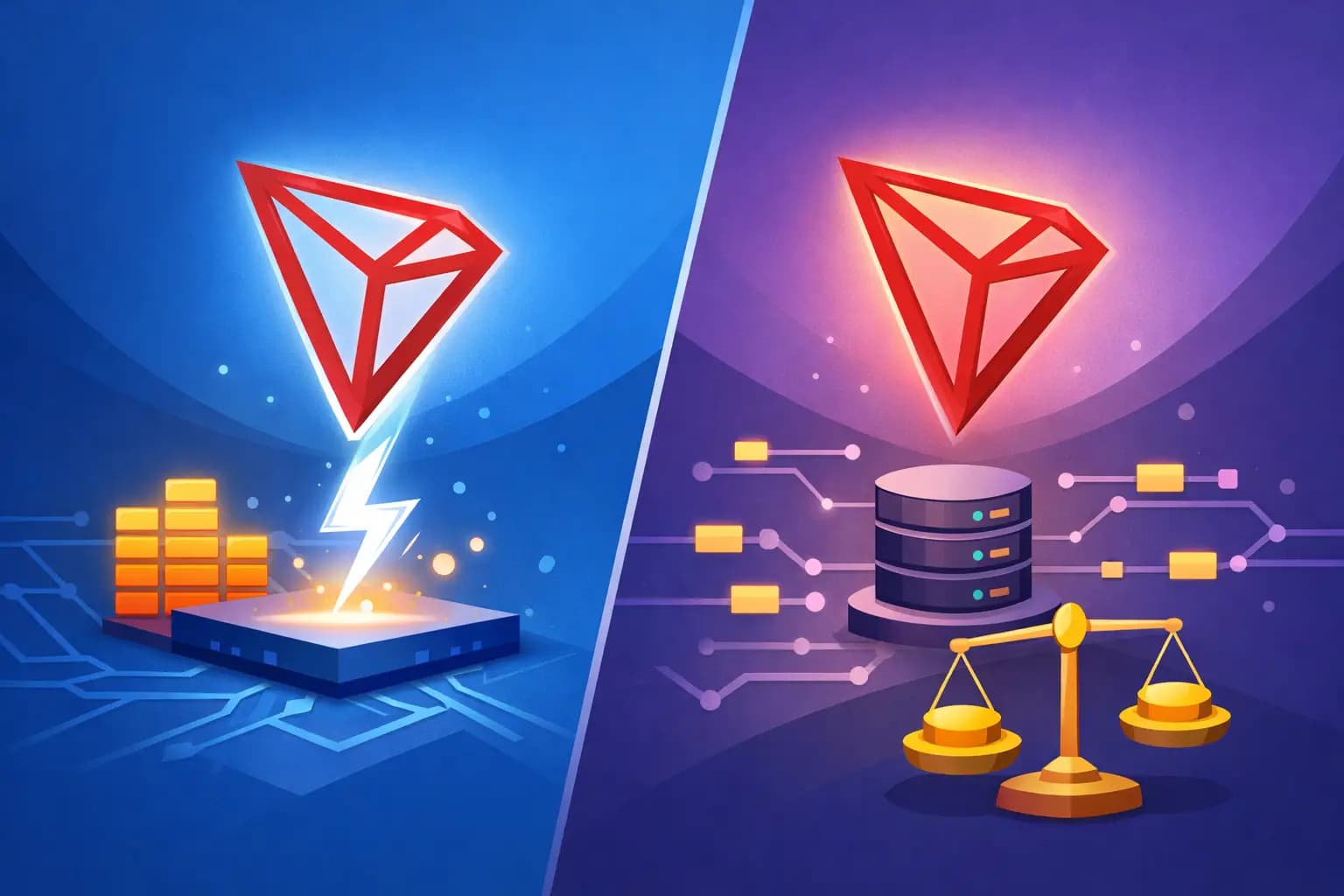
A USDT transfer on TRON can look inexpensive right up until the wallet asks for more TRX than expected. The reason is usually not the token balance. It is the network resource balance. Understanding TRON energy versus bandwidth gives you direct control over how a transaction is paid for, whether you are sending a one-off transfer or moving stablecoins throughout the day.
Both resources reduce the amount of TRX burned for transactions, but they cover different work on the network. Bandwidth pays for transaction data. Energy pays for smart contract execution. A standard TRC-20 transfer needs both, although energy is typically the resource that decides whether your USDT transfer stays cheap.
TRON Energy Versus Bandwidth: The Core Difference
Bandwidth is the basic network resource used to record a transaction on-chain. Think of it as the capacity needed to publish transaction data. Simple actions, such as sending TRX from one address to another, primarily use bandwidth.
Energy is used when a transaction calls a smart contract. TRC-20 tokens, including USDT on TRON, are smart contracts. When you send USDT, the network must execute the token contract's transfer function, update balances, and validate the resulting state. That execution consumes energy.
The practical distinction is straightforward: bandwidth matters for every transaction, while energy matters most when you interact with contracts. If your wallet has enough bandwidth but no energy, a USDT transfer can still burn TRX. If it has energy but insufficient bandwidth, the network can also charge TRX for the missing data resource.
For active TRON users, energy is usually the resource worth planning around. It is the larger variable in many TRC-20 transfer costs.
What Bandwidth Covers on TRON
Every TRON account receives a limited amount of free daily bandwidth through the protocol. This can be enough for occasional TRX transfers and light wallet activity. The allowance regenerates over time, so it is useful for users who do not transact frequently.
Once free bandwidth is used, you can cover the shortfall with bandwidth obtained by staking TRX, or the network can burn TRX to pay the required fee. The amount depends on transaction size and current protocol parameters.
Bandwidth use is generally predictable. A simple transfer creates a relatively small data payload, and the cost does not usually vary as dramatically as smart contract energy use. Still, it should not be ignored. Sending funds to a newly created address, interacting with a contract, or submitting a transaction with more data can require more than a basic wallet-to-wallet transfer.
For a user who mainly sends TRX, staking for bandwidth may be enough. For a user who moves USDT-TRC20, bandwidth alone will not solve the main fee issue.
What Energy Covers on TRON
Energy is consumed by contract execution. This includes token transfers, decentralized exchange actions, staking contracts, and other on-chain functions that run code instead of simply moving TRX between accounts.
A USDT-TRC20 transfer is the common example. The transaction includes the usual data requirement, but it also calls the USDT smart contract. If your account has available energy, the network draws from that balance first. If it does not, the required energy is paid for by burning TRX, subject to the fee limit set in the transaction.
Energy consumption is not always identical from one transfer to the next. The contract call itself is similar, but the chain state and recipient conditions can affect the work required. A transfer to an address that has not previously held that token may use more resources than a transfer to an established token holder. Network rules and contract behavior can also change over time.
That is why copying a fee estimate from a previous transaction is not a reliable operating method. Check the expected resource requirement before sending, especially when the transfer is time-sensitive or the amount is large.
Why USDT Transfers Often Burn More TRX Than Expected
The usual surprise is simple: users see a TRON wallet, hold USDT, and assume the low-fee network means the transaction is effectively free. But USDT does not pay its own network fee. The sender needs TRX or available TRON resources to execute the transfer.
If energy is unavailable, the wallet pays the contract execution cost in TRX. If bandwidth is also unavailable, there may be an additional TRX charge. The token amount can be large or small, but the resource requirement is tied to the transaction mechanics rather than the dollar value being sent.
A $20 USDT transfer and a $20,000 USDT transfer can therefore have similar resource needs when they use the same contract path. This is useful for operators moving larger balances, but it also means small transfers can feel inefficient when they repeatedly burn TRX.
The correct question is not just, "How much USDT am I sending?" Ask, "What contract is this transaction calling, and do I have the resources to execute it?"
Staking, Renting, or Burning TRX
There are three practical ways to cover TRON transaction resources. Each fits a different operating pattern.
Staking TRX can provide energy or bandwidth that regenerates over time. It is best suited to users with a stable transaction volume and TRX they are comfortable allocating for a longer period. The trade-off is capital commitment. Staked TRX is not as immediately flexible as liquid TRX held for trading or transfers.
Renting energy is often more efficient for users with periodic or high-volume TRC-20 activity. Instead of tying up capital, you obtain a defined energy allocation for a selected duration or transaction need. This can work well for treasury workflows, OTC-style settlement, arbitrage routes, payroll batches, and frequent stablecoin movement. The key is matching the order size to expected execution rather than overbuying resources that will sit unused.
Burning TRX is the simplest option. No preparation is required, and it is appropriate for an occasional transfer when speed matters more than optimization. The downside is that repeated burns create an operating cost that can exceed the cost of planned energy access.
There is no universal best choice. If you send USDT once a month, burning a small amount of TRX may be reasonable. If you send it every day, treating energy as a transaction input is usually the better model.
How to Choose the Right Resource Before You Send
Start with the transaction type. A native TRX transfer is primarily a bandwidth event. A TRC-20 transfer, swap, or contract interaction requires energy and bandwidth. This first distinction prevents the common mistake of acquiring bandwidth for a transaction whose main cost is energy.
Next, review your wallet's available resources and TRX balance. Available energy and bandwidth show what the network can consume without burning additional TRX. A separate TRX balance is still useful as a fallback, but relying on it for every token transfer makes costs less predictable.
Then consider frequency. For a single transfer, convenience can outweigh optimization. For recurring operations, estimate your typical daily or weekly contract calls and use that pattern to decide whether staking or rental access makes more sense.
Finally, keep a margin. Resource requirements can vary, and a transaction may need more energy than a previous transfer. Do not provision to the exact minimum if a failed or delayed transfer would disrupt a settlement, trade, or client payment.
A Practical Workflow for TRC-20 Transfers
Before sending USDT or another TRC-20 token, confirm the destination address and ensure it is on the TRON network. Then check the token balance, available energy, available bandwidth, and remaining TRX. These are separate balances with separate roles.
If your energy is low, decide whether the transfer is a one-time event or part of an ongoing workflow. For a one-off transaction, using TRX for the fee may be sufficient. For repeated transfers, obtain energy before initiating the transaction so the cost is known upfront.
After broadcast, track the transaction until it is confirmed and inspect the final resource consumption. This provides a better baseline for future transfers than a generic estimate. Over several transactions, you will see whether your normal activity is bandwidth-light, energy-heavy, or affected by specific recipient conditions.
For teams and frequent users, resource management should sit next to wallet screening and transaction routing, not as an afterthought. A platform such as 2AML can keep TRON energy orders within the same operational environment used for other digital asset tasks, reducing the need to jump between providers when a transfer is ready to send.
The Operational Rule to Remember
Bandwidth gets your transaction data onto TRON. Energy executes the smart contract logic behind token transfers. For TRC-20 users, that difference is the line between an expected low-cost transfer and an unnecessary TRX burn.
Check resources before you confirm, provision energy when transfer volume justifies it, and keep enough TRX available for exceptions. That small habit turns TRON fees from a wallet surprise into a controlled part of your transaction workflow.