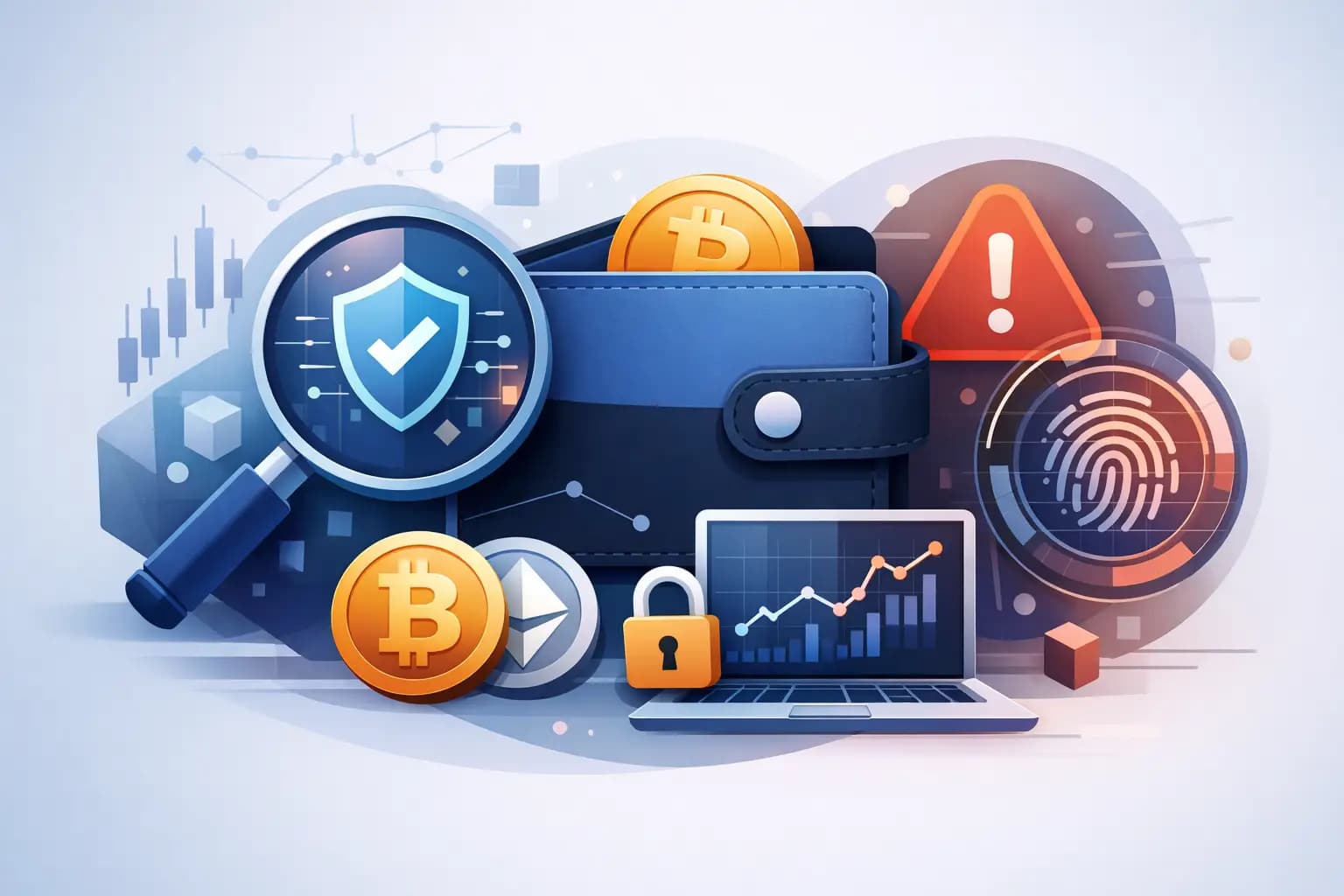
A wallet can look ordinary on-chain and still carry exposure you do not want near your funds. One incoming transfer from a sanctioned service, a scam cluster, or a high-risk exchange can change how a counterparty, exchange, or payment provider views that address. This wallet risk scanner review focuses on the practical question: what can a screening result tell you before you send, receive, swap, or accept crypto?
The short answer is that a scanner gives you a risk signal, not a verdict. Used at the right point in your workflow, it can prevent avoidable delays, rejected deposits, frozen withdrawals, and difficult conversations about transaction history. Used carelessly, it can create false confidence or cause you to reject a legitimate address based on incomplete context.
What a wallet risk scanner actually checks
A wallet risk scanner analyzes public blockchain activity associated with an address. It compares transaction flows, counterparties, and behavioral patterns against datasets that identify known or suspected high-risk sources. Depending on the provider and chain coverage, those sources may include sanctions-related entities, darknet markets, fraud operations, stolen funds, ransomware, mixers, scam services, high-risk exchanges, or gambling platforms.
The output is typically a risk score, a risk level, or both. A useful report should also show the categories behind the result. “High risk” without an explanation is not enough to make an operational decision. You need to see whether the exposure is direct, how material it is, and whether it came from a recent transaction or several indirect hops ago.
That distinction matters. An address that directly received funds from a known scam operation presents a different issue than an address with minor indirect exposure several transactions back. Both may create a flag, but they should not be treated as the same event.
Wallet risk scanner review: what makes a result useful
The best screening tools prioritize clarity over a single opaque score. A score gets attention, but the supporting details determine what you do next. Before relying on any scanner, look at four parts of the result: attribution, proximity, volume, and timing.
Attribution identifies the entity type or risk category connected to the wallet. This is the “why” behind the flag. A label tied to sanctions or theft deserves immediate escalation. A broad category such as high-risk service may require more context before you decide whether to continue.
Proximity shows how close the address is to the flagged source. Direct exposure is generally more meaningful than exposure reached through several intermediary wallets. Some blockchains and asset flows naturally create many hops, particularly when users interact with exchanges, bridges, or DeFi protocols. A scanner that does not distinguish proximity can overstate the practical risk.
Volume reveals how much of the wallet’s activity is connected to the flagged flow. A small historic transfer may not carry the same weight as a large percentage of the address’s total volume. Timing matters for the same reason. Recent exposure can be more relevant to a current transaction than an old, isolated event.
A report is most actionable when these details are visible in one place. You should not have to reconstruct a transaction path manually just to understand a red flag.
Where wallet screening helps most
Screening is most valuable before the irreversible step. Once assets have been sent, your options narrow quickly. For active crypto users, that makes pre-transaction checks especially useful in a few common situations.
If you accept payment in crypto for freelance work, services, OTC-style trades, or digital goods, check a new payer’s address before accepting a large amount. If you move assets to a centralized exchange, screen the source wallet and your destination flow first, especially when the funds have passed through addresses you do not control. If you are considering a direct deal, a scanner adds a layer of visibility that a username, Telegram profile, or transaction screenshot cannot provide.
DeFi users can also benefit when interacting with unfamiliar treasury wallets, distribution contracts, or counterparties receiving settlement. The scanner will not tell you whether a smart contract is safe to approve, but it can reveal whether the wallet behind a proposed transaction has risk signals worth investigating.
For small crypto businesses, the goal is consistency. Establish a simple threshold for when checks are required, such as first-time customers, transactions above a defined amount, or any payment connected to a manual settlement process. A repeatable workflow is faster than making a new judgment under pressure every time funds arrive.
What a scanner cannot tell you
Wallet screening has real limits. It does not prove ownership of an address, prove the lawful source of funds, or predict whether a future transaction will be accepted by every exchange or service. Blockchain intelligence relies on address labeling, transaction analysis, and data coverage. Labels can evolve as new information appears.
It also cannot replace transaction verification. Confirm the chain, token contract, destination address, memo requirements, and expected amount separately. A clean risk result will not rescue funds sent on the wrong network.
Privacy-related transaction flows require particular care. A wallet may receive a higher risk classification after interacting with privacy tools or services, even when the user’s intent was ordinary financial privacy. That does not automatically mean illicit activity. It does mean you should understand the policies of any exchange, counterparty, or off-ramp that will receive those assets later.
The same principle applies to indirect exposure. Blockchains are open systems. Addresses can receive unsolicited transfers, dusting transactions, and funds routed through services with thousands of users. Treat a flag as a reason to investigate, not as a substitute for judgment.
A practical workflow before you send
Start by checking the exact address on the exact network. This sounds obvious, but multi-chain assets create room for mistakes. An address format may be valid across compatible networks while its transaction history and risk context differ by chain.
Next, read beyond the headline score. Identify the flagged category, assess whether the exposure is direct or indirect, and compare the flagged amount with the wallet’s broader activity. If the report shows serious exposure, pause before sending. Ask the counterparty for a different receiving address, request an explanation where appropriate, or avoid the transaction altogether.
For moderate or unclear results, consider the purpose of the transfer. Sending to an unfamiliar counterparty, a regulated exchange, or a business wallet calls for a lower tolerance for uncertainty than moving funds between wallets you personally control. The acceptable risk level depends on the transaction, not only on the score.
Keep a simple internal record for material decisions. Save the address, date, result, and the reason you proceeded or paused. This is useful for teams and equally useful for individual operators who handle many wallets over time. It turns screening from a one-off reaction into an operational habit.
Speed matters, but context matters more
A good scanner should fit naturally into your transaction flow. Long onboarding, unclear credit usage, or reports that hide the underlying categories create friction exactly when you need a fast answer. At the same time, a fast score without context is not a serious risk review.
2AML approaches wallet screening as part of a broader digital asset workflow. You can run account-based AML checks alongside the tools used for swaps, transaction flows, and TRON resource management, reducing the need to move between separate utility services. The practical advantage is operational visibility: check the address, review the signal, then make the next move with more information.
The right decision is not always “send” or “do not send.” Sometimes it is “use another address,” “wait for clarification,” or “keep this transaction away from a service with strict compliance controls.” A wallet risk scanner earns its place in your stack when it helps you make that call before your funds are already in motion.