
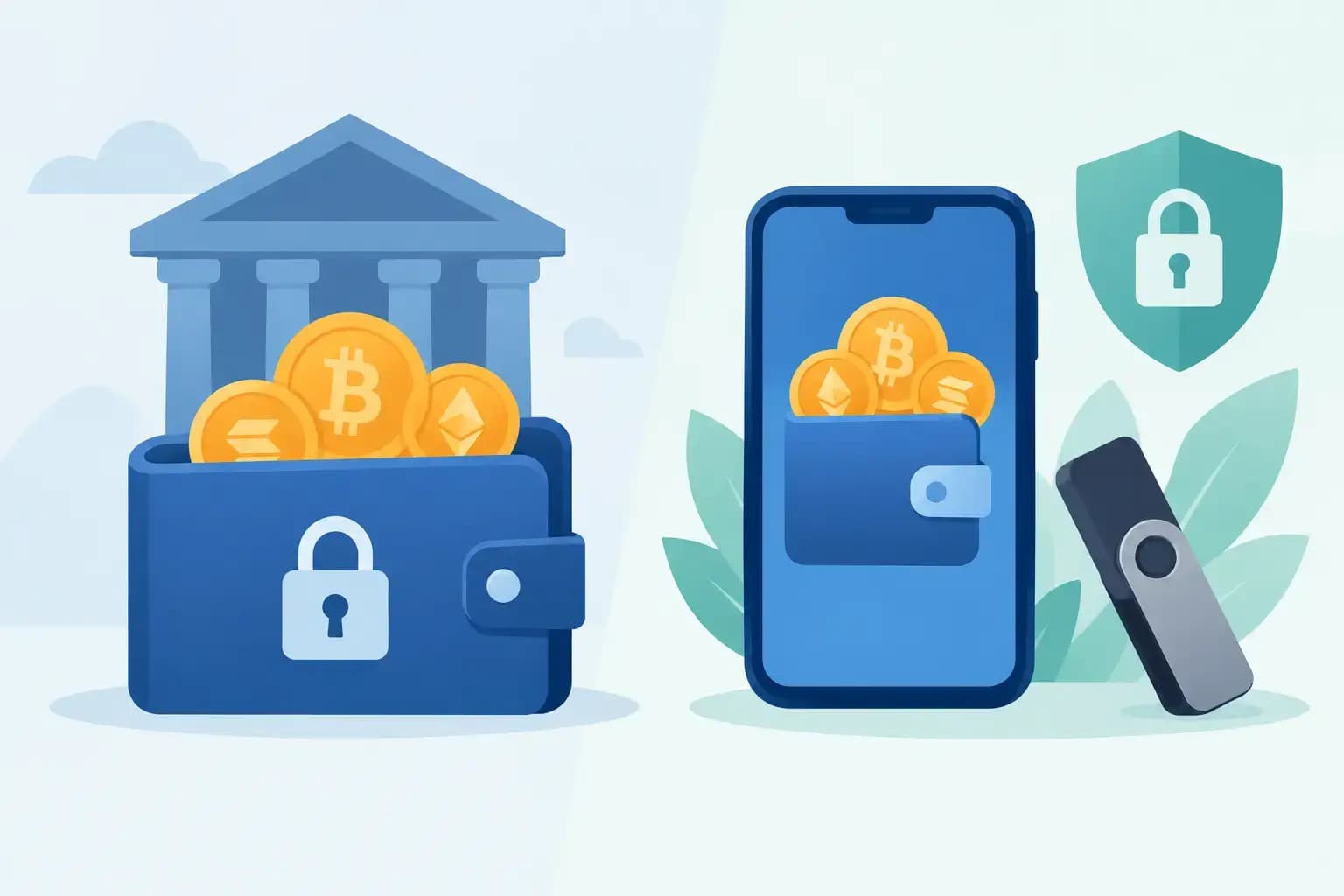
A wallet balance can look identical whether it sits on an exchange or under keys you control. Operationally, the difference is significant. Custodial versus noncustodial crypto services determines who can authorize movement, who carries key-management risk, and what happens when access, compliance, or platform availability becomes a problem.
For active users, this is not a philosophical choice between two labels. It is a workflow decision. The right setup can change by task: holding long-term assets, converting tokens, paying a contractor, reviewing a wallet’s risk exposure, or reducing TRON transaction costs all create different requirements.
What custodial crypto services mean
A custodial service holds assets or controls the private keys required to move them on your behalf. Centralized exchanges are the most familiar example. You deposit crypto to an address controlled by the platform, see a balance in your account, and request withdrawals when you want to move funds elsewhere.
The main advantage is convenience. The provider can handle private-key storage, account recovery, trading infrastructure, and sometimes fiat payment rails. If you lose access to your account, an established provider may have a recovery process. This can be useful for users who do not want the full operational burden of seed phrases, hardware wallets, and transaction signing.
That convenience has a clear trade-off: your ability to move assets depends on the custodian. Withdrawals may be delayed by security reviews, maintenance, jurisdictional requirements, account restrictions, or liquidity conditions. You also take on counterparty exposure. A platform failure, frozen account, compromised internal system, or insolvency event can affect access to funds.
Custody does not automatically mean a service is unsafe. Strong providers use segregated controls, security monitoring, reserves management, and withdrawal protections. But the model requires trust in the provider’s operations and policies, not just in the blockchain.
What noncustodial crypto services mean
A noncustodial service does not hold an ongoing balance for you or retain control of your private keys. You keep assets in a wallet you control and approve transactions from that wallet when needed. No provider can independently move your funds simply because it operates the interface.
This model gives users direct control. Your wallet, keys, and recovery method stay under your authority. You can move funds without requesting a withdrawal from an account provider, provided you have network access, gas fees, and the correct signing credentials.
The trade-off is responsibility. Lose a seed phrase or expose a private key, and there may be no support desk that can reverse the result. Send assets to the wrong network, approve a malicious contract, or sign a deceptive transaction, and blockchain finality can make recovery difficult or impossible.
Noncustodial also does not mean every service interaction is risk-free or fully private. A swap interface, routing provider, smart contract, liquidity partner, or transaction processor may still be involved in executing a transaction. The useful question is specific: who controls the keys and assets before, during, and after the transaction, and what permissions are you granting?
Custodial versus noncustodial crypto services: the real differences
The fastest way to compare custodial and noncustodial crypto services is to focus on control, recovery, and operational dependency.
With custody, the provider holds the keys or has the authority to execute transfers. With noncustodial tools, you sign transactions from your own wallet. That distinction affects everything from account recovery to withdrawal access.
Recovery is more forgiving with a custodian because identity-based account recovery may be available. In self-custody, recovery depends on your backup process. A well-protected seed phrase can be more resilient than an online account, but only if you manage it correctly.
Operational dependency differs too. A custodial account may offer a familiar dashboard and centralized support, but you depend on the provider’s uptime and approval processes. A noncustodial wallet reduces reliance on a single account operator, although you still depend on the underlying chain, wallet software, RPC access, and any protocol used for a specific action.
Privacy and compliance should be considered separately from custody. A noncustodial wallet does not make on-chain activity invisible, and a custodial platform may collect identity information under its policies. Wallet ownership, transaction history, network visibility, and service-level verification are separate variables.
When custody is the practical choice
Custodial services can fit users who prioritize convenience, fiat access, managed security controls, or recoverable account access. They are often useful when you need to convert between crypto and bank funds, operate within an organization that requires permissions, or avoid managing private keys directly.
They can also be practical for short-term trading balances. Keeping only the amount needed for active execution on a custodial venue can reduce the friction of repeated deposits and withdrawals. The key is to treat that balance as platform exposure, not the same as assets under your direct control.
Before depositing, review withdrawal policies, supported networks, security settings, geographic availability, fee schedules, and how the provider handles account reviews. A platform’s advertised trading fee matters less if its withdrawal path is slow, limited, or unclear when you need it most.
When noncustodial services make more sense
Noncustodial tools are usually a better fit when direct asset control is the priority. This includes long-term holders who maintain their own wallet security, DeFi users interacting with protocols, and operators who need to move funds between wallets without maintaining an exchange balance.
They are also useful for modular crypto operations. You may hold assets in a self-custody wallet, check a destination address before sending, use a swap service for a one-time conversion, and manage network resources separately. Each function can be selected for the transaction at hand rather than tied to one custodial account.
That flexibility requires discipline. Use a hardware wallet for material balances when appropriate, protect seed backups offline, verify addresses character by character, and review wallet approvals regularly. For frequent activity, separate operational wallets from long-term storage. A wallet used to test a new protocol should not automatically hold your primary reserves.
How to evaluate a service beyond the label
“Noncustodial” is a useful starting point, not a complete risk assessment. Read the transaction flow before sending funds. Determine whether you are connecting a wallet, depositing into a temporary address, approving a smart contract, or creating an account balance controlled by the service.
Ask practical questions. Does the service ever hold a customer balance? Who selects the route or liquidity provider? Can the transaction be tracked after initiation? What information is required before execution? Are rates, network fees, and expected delivery amounts visible before confirmation? What happens if a route fails or a transfer needs manual review?
For wallet screening, the same discipline applies. An AML risk check can provide useful context about an address, but it does not guarantee an outcome at an exchange, protocol, or payment provider. Use screening to improve decisions before sending, receiving, or engaging with a counterparty, not as a substitute for judgment.
For TRON users, resource management is another operational layer. Renting energy can reduce the cost of eligible transactions, but it does not change wallet ownership or transaction authorization. You still need to confirm the receiving wallet, required resource amount, rental period, and timing before broadcasting.
Platforms such as 2AML are designed around this utility-layer approach: users can route a transaction, review wallet risk, or manage TRON energy without turning the platform into their long-term asset custodian. The value is visibility and task completion, while keys remain with the user where the service flow supports self-custody.
Build a setup that matches the transaction
Many experienced users use both models rather than declaring permanent loyalty to one. They may keep a limited execution balance with a regulated exchange, maintain primary holdings in self-custody, and use noncustodial tools for wallet-to-wallet activity. That is not a contradiction. It is risk segmentation.
The mistake is letting convenience blur the custody model. Know where your keys are, what permissions you have granted, and whether a balance is withdrawable on your timeline. Start small when testing a new route or wallet flow, track each step, and scale only after the process is clear.