
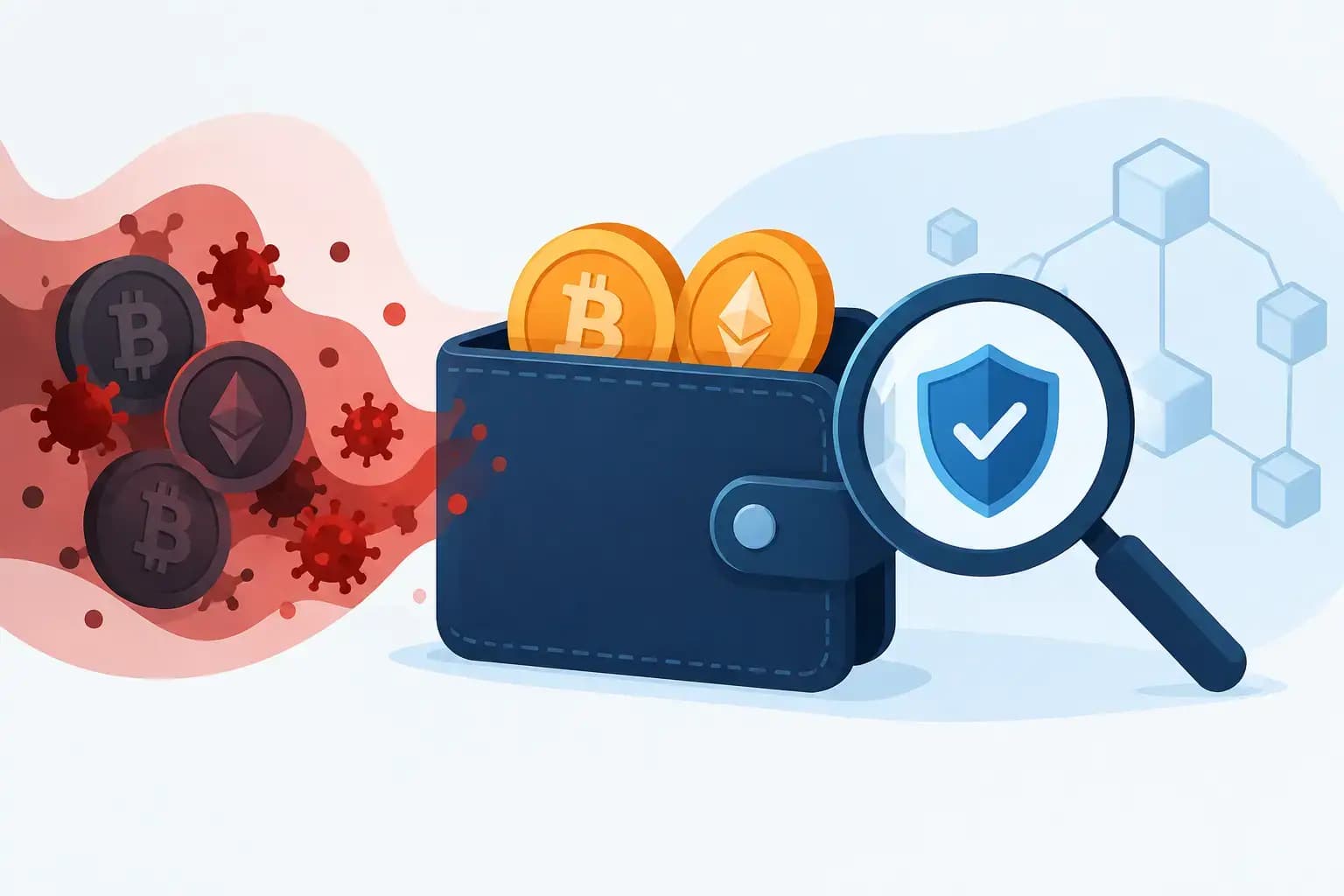
A wallet can be fully under your control and still carry risk signals from funds that passed through it. That is the practical wallet contamination meaning in crypto AML: an address has received, sent, or interacted with assets that blockchain analytics systems associate with elevated-risk activity.
Contamination is not a blockchain status, a criminal finding, or proof that a wallet owner did anything wrong. It is a risk concept used by exchanges, payment services, OTC desks, and compliance teams when they assess transaction history. The distinction matters. A wallet may show exposure because of one small incoming transfer, while another may have a repeated and direct relationship with high-risk sources. Those cases should not be treated the same.
What wallet contamination means in practice
Public blockchain records make transaction paths visible. AML analytics tools analyze those paths, label known entities and patterns, and assign risk based on a wallet's connections. If an address receives funds from a sanctioned entity, a scam-related address, a dark-market service, a hacked protocol, or a high-risk mixer cluster, it may be flagged as exposed or contaminated.
The label usually refers to exposure, not ownership. For example, a freelancer may receive a payment from a client wallet that previously received funds from an unknown high-risk source. The freelancer did not necessarily know about that history. Still, an exchange reviewing a later deposit may see the connection and request more information.
This is why wallet risk is operational, not merely theoretical. Once funds move through your address, their history can affect where you can send them next and how a counterparty reviews the transaction.
How contamination is measured
Wallet contamination is rarely a simple yes-or-no decision. Screening providers use different data sources, entity labels, scoring models, and exposure rules. A result can vary depending on the provider and the destination platform's internal policy.
Direct and indirect exposure
Direct exposure means your wallet transacted with a flagged address or entity. If a known scam address sends USDT directly to your address, that is a clear first-hop connection.
Indirect exposure occurs when funds move through one or more intermediary wallets before reaching you. A second- or third-hop connection is generally less meaningful than direct exposure, but it can still contribute to a risk score. The further the transaction path, the more context matters.
Amount and proportion
A $5 transfer linked to a risky source does not carry the same operational weight as a transfer that makes up most of a wallet's balance. Compliance systems may consider the percentage of wallet value tied to a risky source, not only the total amount.
If a small contaminated amount sits alongside a long history of legitimate activity, that may produce a different assessment than a new wallet funded almost entirely by a high-risk address. Risk is contextual.
Source category and behavior
Not all alerts have equal severity. Exposure to a sanctioned entity or a confirmed exploit can trigger stronger controls than exposure to a gambling service or an unlicensed exchange. Categories also change over time as data providers identify new addresses, investigate incidents, and update attribution.
Behavior matters too. Repeated interactions, rapid pass-through movements, unusually fragmented transfers, and links to multiple flagged clusters can look more concerning than a single isolated receipt.
Why a contaminated wallet can create friction
The blockchain will not stop a transaction because an analytics platform considers an address high risk. You can often still broadcast the transfer and see it confirm normally. The friction appears when a regulated or policy-driven service receives the funds.
A centralized exchange may pause a deposit, request source-of-funds documentation, limit withdrawals, or decline the transaction. A business paying vendors in crypto may need to investigate before accepting an incoming payment. An OTC counterparty may ask for an explanation of the transaction route.
That does not mean every flagged wallet will be blocked. Each service has its own risk tolerance, geography, licensing obligations, and internal review process. But sending unreviewed funds to a destination where access matters can create avoidable delays.
For active users, the key question is not, "Can I send this?" It is, "Will this route create a review at the next service I rely on?"
What does not automatically count as contamination
A few common assumptions create unnecessary panic. Receiving funds from an unfamiliar address is not automatically evidence of wrongdoing. A blockchain explorer displaying a large number of historical transactions is not an AML risk determination. Using a privacy-oriented tool or interacting with a decentralized protocol is not, by itself, a universal indicator of illicit activity.
The practical issue is how a specific screening provider classifies the associated source and how directly the funds can be traced. Policies differ, and labels can be incomplete or incorrect. Analytics systems are useful for decision-making, but they are not infallible.
This is also why a clean result should be understood correctly. It generally means no relevant risk exposure was identified under that provider's current data and rules. It is not a permanent guarantee that an address will never be linked to a newly identified incident later.
How to check wallet exposure before a transaction
The most efficient time to screen an address is before sending funds to an exchange, business partner, customer, or new counterparty. Check both sides when the transaction is material: the wallet you are sending from and the receiving address if you need to understand counterparty risk.
Start with the exact address and correct network. USDT on TRON, Ethereum, and other networks uses different address environments and transaction records. A screening decision based on the wrong chain is not useful.
Review the result beyond the headline score. Look for the risk category, whether the exposure is direct or indirect, the transaction distance, and the amount involved. A high-level alert without context is not enough to make a sound routing decision.
If the wallet is your own and a result appears unexpected, preserve the transaction records. Keep invoices, payment agreements, exchange withdrawal confirmations, and relevant communications. Documentation does not erase a risk signal, but it can help explain legitimate activity if a service asks questions later.
For recurring operations, screen before accepting large payments, before consolidating balances, and before depositing to a platform that is essential to your workflow. A pre-transaction AML check is usually faster than responding to a hold after the transfer has arrived.
What to do if a wallet shows risk
Do not assume you can solve a risk result by moving funds through multiple wallets. Layering transactions to obscure source history can create more concern, not less. Blockchain analytics follows transaction paths, and unnecessary hops often make later review harder.
Instead, identify the exposure. Was it a direct incoming payment? A historical interaction with a service? A dusting transaction? A false or outdated attribution? The answer determines the next step.
For a minor or indirect alert, you may decide the operational risk is acceptable for a low-stakes transaction. For direct exposure to serious categories, pause before sending funds to a regulated destination. Gather documentation and, where needed, use the receiving platform's compliance channel to clarify the situation before initiating a larger deposit.
If you are accepting crypto payments for work or a small business, establish a simple policy: screen significant incoming wallets before delivering irreversible goods, releasing services, or sending payouts. This protects more than your current transaction. It helps preserve access to the exchanges, payment routes, and counterparties that keep your operation moving.
Build screening into your transaction flow
Wallet screening works best as a routing control, not as a last-minute emergency tool. Check a new counterparty before the first large transfer. Recheck addresses after a long gap or before a materially larger payment. Keep business and personal flows separated where practical, so one unexpected receipt does not complicate every future transaction.
For users who move assets across networks, swap frequently, or operate with multiple counterparties, a quick AML review creates useful visibility before assets reach a sensitive destination. 2AML can fit into that process by providing wallet risk checks alongside other crypto operations, without requiring you to hand over custody of your funds.
A contaminated-wallet alert is not a verdict. It is a prompt to examine transaction history, understand the route, and choose the next transfer with better information. That small check can be the difference between a routine deposit and an avoidable operational delay.