
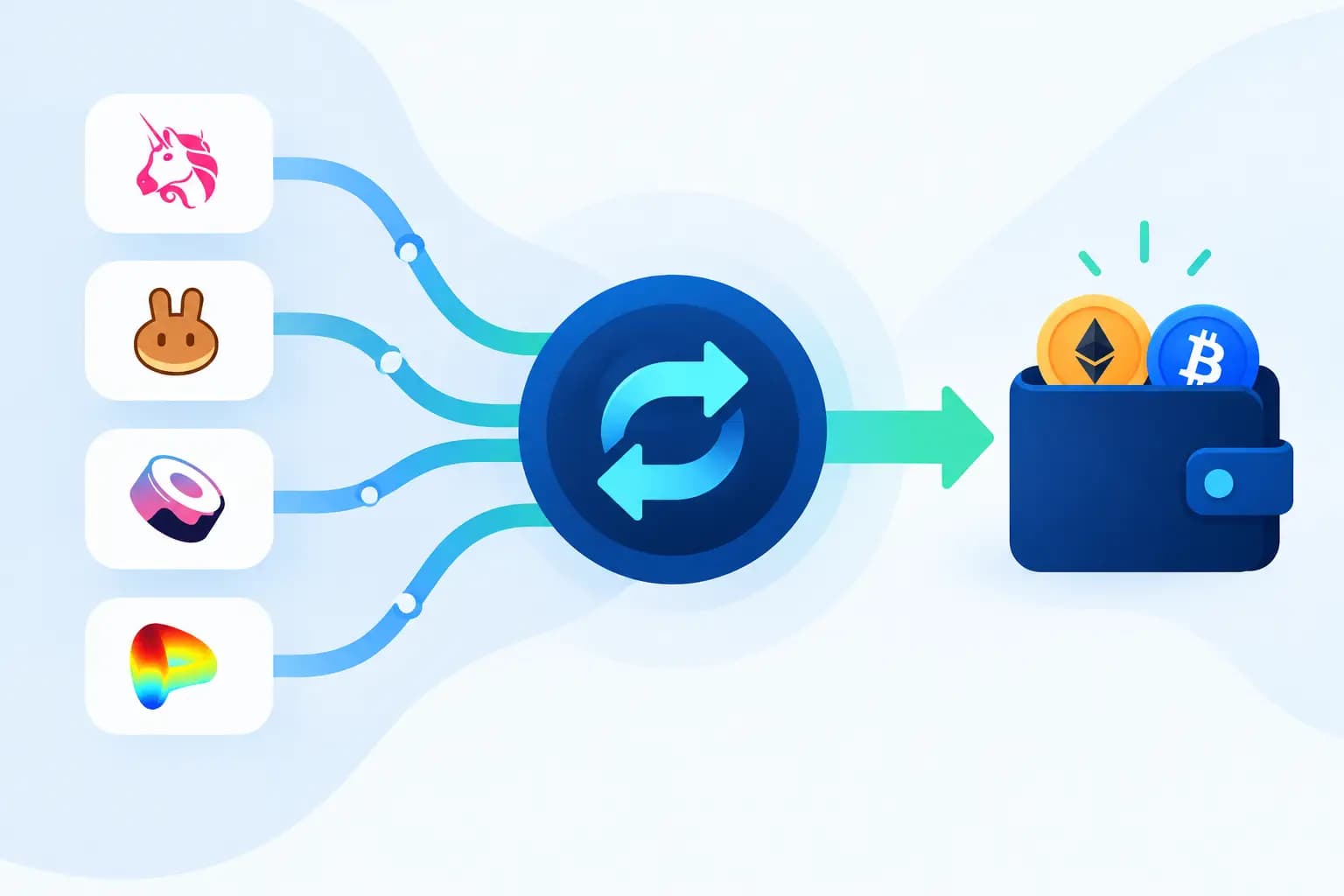
A swap can look simple until the quote changes between approval and execution, the route uses an unexpected intermediary asset, or a transaction sits pending with no clear next step. For active wallet users, crypto swap aggregators solve a practical routing problem: finding and executing a conversion across available liquidity sources without manually checking each one.
That convenience is valuable, but an aggregator is not a magic price button. The route it selects, the network you use, the amount you trade, and the fees attached to the transaction all affect the final result. Understanding those moving parts helps you use aggregators with more control and fewer surprises.
What Crypto Swap Aggregators Actually Do
A crypto swap aggregator collects quotes from multiple exchange partners, liquidity providers, decentralized protocols, or other routing sources. Instead of opening several services to compare a USDT-to-ETH conversion, you enter the assets and amount once. The aggregator returns an available quote and creates the transaction flow around it.
Its main job is routing. A direct pair may offer the best result for one trade, while another trade may need to move through an intermediate asset or a different provider to get better pricing or faster completion. The aggregator evaluates available options based on its integrated sources and presents a route it can execute.
This differs from a single swap provider, which can only quote from its own liquidity, inventory, or selected partners. An aggregator expands the set of routes available to the user. That can improve execution, especially when a direct market is thin or when price differences between sources are meaningful.
The keyword is available routes, not guaranteed best price. No aggregator sees every source in the market, and the best displayed quote can change quickly. Treat the quote as a time-sensitive operational estimate with stated terms, not as a permanent market price.
Why Routing Matters More Than the Headline Rate
The rate displayed at the start of a swap is only one part of execution. What matters is the amount that arrives in the destination wallet, the time it takes, and the conditions that could alter the outcome.
For a small, liquid swap, routing differences may be minor. For a larger amount, a less common token, or an asset moving across networks, route selection can have a visible effect. Liquidity may be split among providers. One route might offer a stronger initial quote but require extra on-chain steps. Another may have a slightly lower quote but complete more predictably.
Slippage is a major factor. It is the difference between the expected price and the price achieved when the transaction executes. In volatile markets or shallow liquidity, the price can move while a transaction is waiting for confirmations. Some services build a buffer into the quote, while others use fixed-rate or floating-rate structures. Read which model applies before sending funds.
Fees also need to be evaluated as a complete package. A low service fee does not automatically mean the lowest total cost. Network fees, provider spreads, bridge costs, and minimum-output rules can change the final amount. The useful comparison is simple: how much of the destination asset will reach your wallet under the route shown?
The Swap Flow: What to Check Before You Send
A reliable aggregator reduces manual work, but users still control the transaction inputs. Before confirming a swap, verify the source asset, destination asset, network, and receiving wallet address. Network mismatches remain one of the most expensive avoidable errors in crypto operations.
Check whether the destination asset is issued on the expected chain. USDT on TRON, Ethereum, Solana, and other networks are not interchangeable transfer formats. The ticker may be the same, but the receiving requirements, transaction costs, and compatible wallet addresses can differ.
Then review the quoted output, the route conditions, and the expected processing time. If the amount is material to your operation, consider testing a new route with a smaller transaction first. This is especially useful when using an unfamiliar asset, a newly added network, or a wallet destination you have not previously used.
You should also keep enough native network asset in the sending wallet to cover the required transaction fee. A wallet can hold the token you want to exchange and still fail to broadcast because it lacks ETH, TRX, SOL, or another network gas asset.
Once funds are sent, use the transaction ID and status tracker rather than relying on wallet balance changes alone. A good tracking flow should show whether the deposit has been detected, whether the exchange is in progress, and whether the payout has been sent. This visibility separates a manageable delay from an actual issue that needs support attention.
Fixed and Floating Rates Serve Different Jobs
Most crypto swap aggregators offer, or route through providers that offer, fixed-rate and floating-rate transactions. Neither is universally better. The right choice depends on your priority.
A fixed rate prioritizes output certainty within the service's stated conditions. It can be useful when you need a known amount for a payment, a portfolio rebalance, or a time-sensitive operational transfer. The trade-off is that fixed quotes may include a wider buffer against market movement or may expire quickly.
A floating rate follows the market until the route executes. It can produce a better outcome if pricing moves in your favor, but it also exposes you to adverse movement. Floating rates often make sense for routine conversions of liquid assets when the exact destination amount is less critical than accessing the current market route.
Do not choose based on the label alone. Compare the actual output, conditions, and timing. In a fast market, a quote that looks slightly better may not remain available long enough to matter.
Where Aggregators Have Limits
An aggregator simplifies access, but it does not remove blockchain and market risk. Transactions can be delayed by network congestion, provider processing, liquidity changes, or compliance reviews triggered by a routing partner. Once a blockchain transfer is confirmed, it is generally not reversible.
Privacy also requires clear expectations. Using a non-custodial swap flow can reduce the need to leave assets on a centralized exchange account, but most public blockchain transactions remain visible on-chain. Wallet activity, token movements, and transaction timing may still be analyzed. Operational privacy is not the same as invisibility.
For users moving funds frequently, counterparty and wallet risk deserve attention alongside price. A clean-looking address or a favorable quote does not establish that a wallet is safe to transact with. Screening a destination or counterparty wallet before sending material value can add a useful control point to the workflow.
This is where a consolidated operations layer can reduce tool switching. 2AML combines swap execution with wallet AML risk checks and TRON energy tools, allowing users to handle related transaction tasks without treating each step as a separate operational problem.
How to Use an Aggregator More Effectively
Start with the outcome you need, not the token pair alone. If your priority is a known payout, favor routes and rate types built for certainty. If speed matters most, choose a supported network with predictable confirmation times and confirm that the destination wallet can receive the asset immediately.
For larger transactions, avoid assuming that one large swap will always be optimal. Depending on liquidity and market conditions, splitting activity into planned portions may reduce execution risk. That approach also has trade-offs: more transactions can mean more network fees and more time spent monitoring status.
Keep records of the quoted amount, transaction ID, destination address, and final received amount. This is useful for personal tracking, business reconciliation, and support requests. It also helps identify patterns, such as whether a specific network, asset pair, or transaction size repeatedly produces slower execution.
Finally, do not rush an unfamiliar route because a number looks attractive. Confirm the network, read the conditions, send only from a wallet you control, and track each stage after broadcast. The best swap workflow is not just fast - it is one you can verify from the first quote to the final payout.